

Bangladeshis Lose 5.5 Years of Life Expectancy to World’s Worst Air Pollution, Report Finds
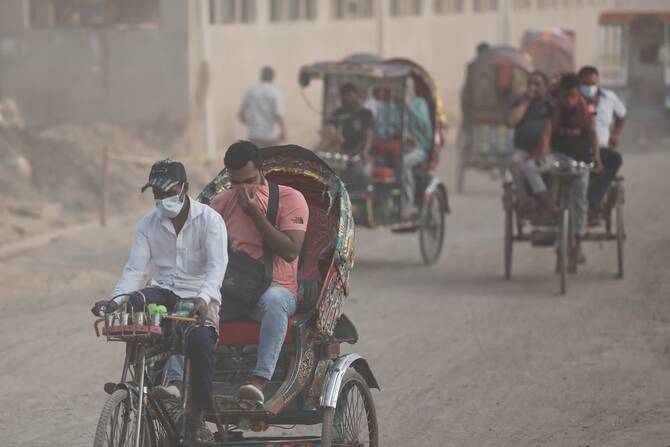
DHAKA: Air pollution is cutting the average Bangladeshi’s life expectancy by 5.5 years, the steepest loss worldwide, according to new research that has intensified calls for urgent government action.
The Air Quality Life Index (AQLI) report by the University of Chicago’s Energy Policy Institute, released last week, identifies Bangladesh as “the world’s most polluted country,” with air pollution described as “the greatest external threat to life expectancy.”
All of Bangladesh’s 166.8 million people live in areas where fine particulate matter (PM2.5) levels exceed both the World Health Organization’s recommended annual guideline of 5 micrograms per cubic meter and Bangladesh’s own national limit of 35 micrograms. In Dhaka, the concentration exceeds 76 micrograms, slashing life expectancy in the capital by 6.9 years.
“The average Bangladeshi could live 5.5 years longer if particulate pollution met the WHO guideline,” the report says. The situation has worsened since last year’s AQLI, which estimated a 4.8-year reduction.
Experts say smog has become a daily reality, while the more dangerous threat comes from invisible PM2. 5 particles that penetrate deep into the lungs and bloodstream.
“It’s very concerning for us. Air pollution has reached such a severe level here that no research is needed to identify it one can see it with the naked eye,” said Dr. Ahmad Kamruzzaman Majumder, professor of environmental science at Stamford University in Dhaka.
PM2.5 levels have steadily risen since the late 1990s, with only a brief decline during the COVID-19 pandemic. Sources include vehicle emissions, brick kilns burning coal and wood, open waste burning, and transboundary pollution from neighboring countries. An estimated 100,000 new vehicles are added annually to Dhaka’s streets, many without proper fitness checks.
Government officials acknowledged the gravity of the crisis but said efforts are underway. Dr. Ziaul Huq, director of air quality management at the Department of Environment, said, “Big industries responsible for air pollution will be brought under constant monitoring. Devices will be installed at factory furnaces, and emissions will be monitored centrally. If deviations are found, we will intervene immediately.”
He added that the initiative, part of the “Bangladesh Clean Air” project, will begin within two months. However, he admitted challenges remain, particularly in tackling cross-border pollution, which accounts for up to 35% of Dhaka’s air quality problem between October and April.
“Thirty-nine percent of Dhaka’s air pollution comes from burning waste and firewood. We couldn’t address this issue properly. Our efforts are there, but more needs to be done,” Huq said.
Environmentalists warn that unless decisive measures are taken soon, Bangladesh risks worsening health crises, reduced productivity, and deeper social inequality linked to the country’s toxic air.