

India Commits to Strengthening Ties With China as Modi Meets Xi at SCO Summit
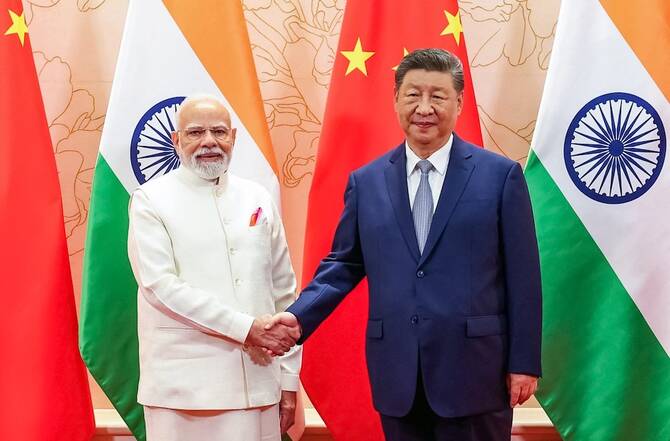
NEW DELHI: India is committed to improving its relationship with China, Prime Minister Narendra Modi said during a meeting with Chinese President Xi Jinping on Sunday, as the two Asian powers explore ways to reset ties strained by years of border tensions.
Modi met Xi on the sidelines of the Shanghai Cooperation Organization (SCO) summit in Tianjin, attended by leaders from Russia, Central Asia, and South Asia. This marks Modi’s first visit to China since the 2018 SCO summit in Wuhan. Relations soured in 2020 following deadly clashes along the Himalayan border, known as the Line of Actual Control (LAC).
Talks over the disputed frontier resumed earlier this month with the visit of China’s top diplomat, Wang Yi, to New Delhi.
“An atmosphere of peace and stability has been created after the disengagement on the border. Agreements have been reached between our special representatives regarding border management,” Modi said in his opening remarks, which he later shared on social media.
“The interests of 2.8 billion people of both countries are linked to our cooperation. This will also pave the way for the welfare of all of humanity. We are committed to taking our relations forward on the basis of mutual trust, respect, and sensitivity,” he added.
The 2020 standoff saw tens of thousands of troops, tanks, and artillery deployed on both sides of the LAC, with both countries constructing new roads, bunkers, and airstrips in the high-altitude region. In response, India imposed restrictions on Chinese investments, banned dozens of apps, and deepened security ties with the US, Japan, and Australia.
But tensions with Washington have given New Delhi fresh impetus to engage Beijing. Earlier this month, US President Donald Trump raised tariffs on Indian exports over New Delhi’s purchases of Russian oil, complicating India’s economic position.
India’s Ministry of External Affairs said Modi emphasized that both countries “pursue strategic autonomy, and their relations should not be seen through a third-country lens.”
Analysts say the statement reflects India’s push for a multipolar Asia. Manoj Kewalramani, chairperson of the Indo-Pacific Research Program at the Takshashila Institution, noted, “It is high time that Beijing began viewing India for India’s sake, and not via Washington, D.C.-tinted glasses.”
While both sides agree on the idea of global multipolarity, Kewalramani pointed out that differences remain over whether this vision extends to Asia itself. “The Indian readout reiterates this objective of Asian multipolarity, whereas the Chinese readout does not,” he said.