

US House Votes to Restrict Trump Over Iran War as Gulf Tensions Escalate
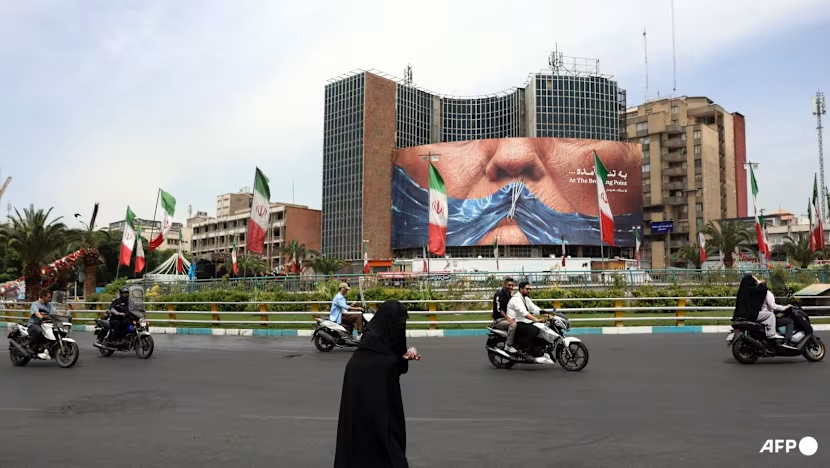
KUWAIT CITY: The US House of Representatives has passed a resolution aimed at curbing American military action in Iran, delivering a political setback to President Donald Trump as diplomatic efforts to end the conflict and restart talks on the Strait of Hormuz remain stalled.
The resolution passed narrowly by 215–208, with four Republican lawmakers joining Democrats in backing the largely symbolic measure. While it reflects growing political pressure, the move can still be vetoed if it clears the Senate.
Democrats described the vote as a “clear message” against what they called an “unpopular and illegal war of choice”, as tensions between Washington and Tehran continue to escalate.
The development comes amid ongoing indirect negotiations between the United States and Iran, which have so far failed to produce tangible progress. Tehran said on Wednesday that talks had made “no tangible progress”, while Trump expressed optimism that a breakthrough “could happen over the weekend”.
The Strait of Hormuz, a critical global energy shipping route, remains at the centre of the dispute as both sides disagree over nuclear restrictions and regional security guarantees.
At a congressional hearing, US Secretary of State Marco Rubio said discussions are focused on Iran’s highly enriched uranium stockpiles, which Washington insists must be handed over as part of any potential agreement.
US demands also include curbs on Iran’s nuclear programme and the reopening of the Strait of Hormuz to ensure stable global energy flows.
Meanwhile, Iranian Foreign Minister Abbas Araghchi said communication channels with Washington remain open but warned of serious consequences if Israel expands military action into Beirut, describing it as a potential trigger for a wider regional escalation.
“No tangible progress has been made in the negotiation process,” he was quoted as saying, while stressing that Iran’s armed forces are prepared to respond to further attacks.
The region has also witnessed renewed violence, including an Iranian drone strike on a passenger terminal at Kuwait International Airport on Wednesday that killed one person and injured 63 others, according to Kuwaiti authorities.
Kuwait condemned the attack as “criminal Iranian aggression”, while Iran’s Revolutionary Guards denied responsibility, claiming the incident was due to a failure in US Patriot defence systems.
The airport temporarily suspended operations following the strike before resuming flights later.
The escalation marks one of the most serious flare-ups since a fragile ceasefire took effect earlier this year, though both sides continue to exchange accusations and sporadic strikes.
Further complicating the situation, Israel and Lebanon have reportedly agreed to a ceasefire framework following US-mediated talks, including provisions for Lebanese armed forces to take control of designated zones.
However, violence between Israel and Hezbollah has continued, with both sides reporting fresh attacks and casualties in southern Lebanon.
Israeli Prime Minister Benjamin Netanyahu accused Iran of “playing with fire”, warning that military operations could resume if tensions continue to rise.
With diplomacy faltering and regional clashes intensifying, concerns are growing over a wider conflict that could further destabilise global energy supplies and security in the Middle East.