

U.S. Base in Syria Targeted Amid Rising Tensions with Iran; All 27 U.S. Installations in the Region on High Alert
A U.S. military base in northeastern Syria came under mortar fire on Monday, heightening concerns over the safety of all 27 American military installations across the Middle East amid escalating tensions with Iran.
According to reports by Iran’s Mehr News Agency, the attack took place near the Khasrok area of Hasakah province. Local sources said loud explosions were heard around the facility, and heightened military activity was observed immediately afterward. U.S. forces reportedly secured the perimeter, with drone and helicopter patrols deployed over the region.
Though no immediate details on casualties or damage were released, regional analysts say the attack is part of a broader warning amid Iran’s vow to retaliate for recent U.S. airstrikes on its nuclear facilities.
U.S. Bases Within Iran’s Missile Range
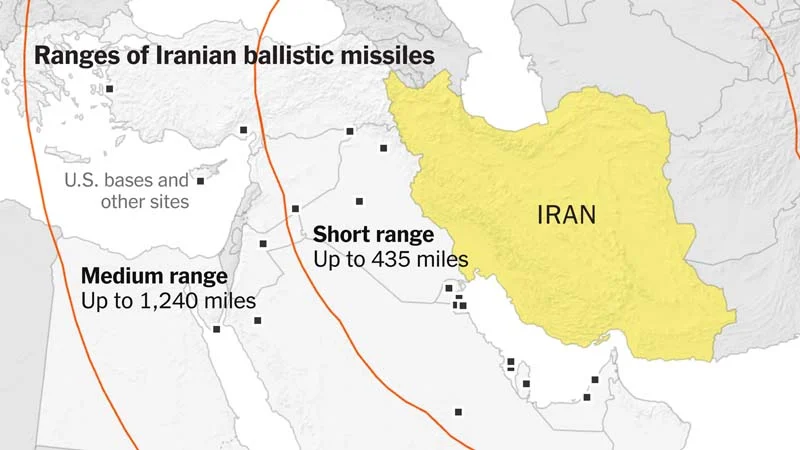
The United States maintains at least 27 military bases across the Middle East, with 12 of them actively operating for more than 15 years. Analysts warn that these sites—including those in Qatar, Bahrain, Kuwait, Saudi Arabia, Iraq, and Syria—are within the 2,000 to 2,500 km range of Iran’s ballistic missiles.
“Iran has repeatedly warned that if its nuclear sites are attacked, it will respond not only against Israel but also U.S. interests throughout the region,” said political commentator Barak Ravid to CNN.
Iran possesses a range of short- and medium-range ballistic missiles, including the Shahab, Ghadr, Sejjil, and Khorramshahr models. While Iran has not publicly tested any intercontinental ballistic missiles (ICBMs)—which typically have a range of over 5,500 km—Western intelligence agencies believe Tehran may be developing such capabilities.
Proxy Forces and Regional Mobilization
Iran’s Islamic Revolutionary Guard Corps (IRGC) is believed to be reactivating allied militias in Iraq, Syria, and Yemen. These groups have previously targeted U.S. military bases and diplomatic assets.
In Yemen, the Iran-backed Houthi movement issued a fresh threat, warning that if the U.S. joins a direct war against Iran in support of Israel, it will target American vessels in the Red Sea.
This warning follows an increase in missile attacks from Iran on southern Israel in response to U.S. strikes on the Fordow, Natanz, and Isfahan nuclear sites—an operation Tehran calls a clear act of war.
Global Calls for De-escalation
China has urged both Iran and Israel to de-escalate hostilities, warning that continued conflict could lead to a full-scale regional war. On Monday, Chinese Foreign Ministry spokesperson Guo Xiaokun said:
“We call on all parties to exercise restraint, avoid further provocation, and return to the path of political resolution.”
Meanwhile, U.S. Secretary of State Marco Rubio appealed to Beijing to prevent Iran from closing the Strait of Hormuz, a critical global oil transit route, which is now at risk following the strikes.
Strategic Uncertainty for the U.S.
The attack on the U.S. base in Syria is being seen by analysts as a symbolic and strategic signal in the wake of recent U.S.-Israeli operations targeting Iranian nuclear infrastructure. Experts believe this assault—while limited in scale—underscores how vulnerable U.S. assets remain in the region.
Though similar rocket and drone attacks have previously occurred in Syria, often attributed to Iran-aligned militias, Monday’s assault stands out due to its timing and potential linkage to the larger regional conflict involving Israel, the U.S., and Iran.
As the region teeters on the edge of a broader war, U.S. military installations across the Middle East remain on high alert, and Western intelligence agencies are monitoring closely for signs of further retaliation by Iran or its proxy forces.