

‘Genocide-free’ cola gains prominence in the United Kingdom
The Hiba Express, a fast food establishment in Holborn, a bustling central London neighborhood filled with restaurants, bookstores, and shops, bustles with customers on a sunny autumn day. Above Hiba stands Palestine House, a multistory gathering space for Palestinians and their supporters. Built in the style of a traditional Arabic house, it boasts stone walls and a central courtyard with a fountain.
Osama Qashoo, a fascinating man with pulled-back hair, a thick beard, and a moustache that ends in magnificent curls, operates Palestine House in the six-story structure. He co-founded Hiba Express in 2012 and maintained his connection with the restaurant until 2020.
The Hiba Express menu features Palestinian and Lebanese delicacies. The room, decked with pleasant colors, tree branches, and signs with phrases like “From the river to the sea,” hosts patrons who spread halloumi cheese, chickpeas, and falafel around their plates. A doll clad in a black-and-white keffiyeh scarf sits on a table near the eatery’s entrance, with a placard above it scrawled in blood-colored ink: “Save the children.” This is in reference to the thousands of Palestinian youngsters killed in Israel’s attacks on Gaza over the last year.
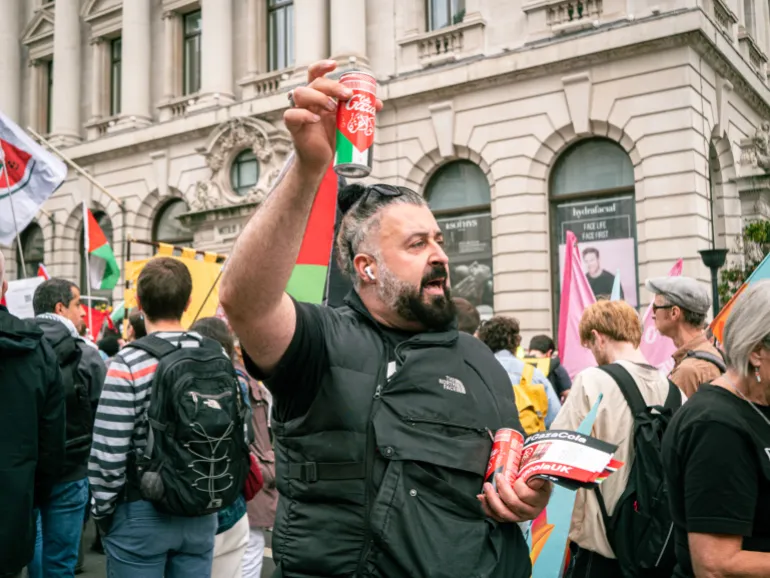
The Palestinian flag’s black, white, and green stripes, Arabic artwork, and a keffiyeh design adorn cherry-red soda cans on numerous tables. Arabic calligraphy, identical to the script of a prominent cola brand, adorns “Gaza Cola.”
It’s a beverage with a message and a purpose.
Qashoo, 43, is eager to point out that the drink, which is manufactured from conventional cola ingredients and has a sweet and acidic taste similar to Coca-Cola, “is totally different from the formula that Coke uses.” He won’t reveal how or where the recipe came from, but he will confirm that he invented Gaza Cola in November 2023.
Nynke Brett, 53, from Hackney, east London, found Gaza Cola while attending a cultural event at Palestine House. “It isn’t as carbonated as Coke. It’s smoother and gentler on the palate,” she explains. “And it tastes even better because you’re supporting Palestine.”
Qashoo founded Gaza Cola for a variety of reasons, the first of which was to boycott firms that fund and feed the Israeli army, as well as the slaughter in Gaza. Another reason is to find a taste that is guilt-free and does not involve genocide. “The true taste of freedom.”
Although it may sound like a marketing slogan, Qashoo holds a deep passion for Palestinian liberation. He co-founded the International Solidarity Movement (ISM) in 2001, a nonviolent direct action organization that challenges and resists Israel’s occupation of Palestinian territory.
This organization laid the ground for the Boycott, Divestment, and Sanctions (BDS) movement four years later, according to Qashoo. BDS boycotts companies and products that it claims play a direct role in Israel’s persecution of Palestinians.
Qashoo was forced to escape Palestine in 2003 after organizing nonviolent rallies against what he refers to as Israel’s “apartheid wall”—a” separation barrier built inside the West Bank that is recognized as a barrier between Israel and Palestinian land.
He moved to the UK as a refugee and became a film student, committed to telling Palestinian tales through film. His trilogy, A Palestinian Journey, received the 2006 Al Jazeera New Horizon Award.
In 2007, Qashoo co-founded the Free Gaza Movement, which sought to end Gaza’s unjust embargo. Three years later, in 2010, he helped organize the Gaza Freedom Flotilla operation, which transported humanitarian aid from Turkey to Gaza by water. In May 2010, an attack on the Mavi Marmara, one of the flotilla’s ships, resulted in Qashoo losing his cameraman and film equipment.
Later, they captured him and tortured him in prison, along with about 700 others. His family staged a hunger strike until he was safe.
After moving to the UK, Qashoo continued his advocacy work but struggled to pursue a career in filmmaking. He eventually became a restaurateur. But he never planned to sell carbonated beverages. “I wasn’t even thinking about this” until late last year, Qashoo admits. He also expressed his intention to create a product that exemplifies trade rather than aid.
According to George Shaw, an analyst at GlobalData, 53% of Middle Eastern and North African consumers are boycotting products from specific companies in response to recent wars and crises.
“These companies that fuel this genocide, when you hit them in the most important place, which is the revenue stream, it definitely makes a lot of difference and makes them think,” said Qashoo. Gaza Cola, he adds, is “going to build a boycott movement” that will financially harm Coke.
Coca-Cola, which has operations in the Israeli Atarot industrial colony in occupied East Jerusalem, faced a new boycott on October 7 last year.
Family has also played a role in Qashoo’s efforts to launch Gaza Cola. He doesn’t know the whereabouts of his adopted 17-year-old son in the West Bank, who suffered a head shot in June.
“My family in Gaza has suffered greatly,” asserts Qashoo. “I’ve got friends—I don’t know where they are.”
Qashoo admits that inventing Gaza Cola was difficult, despite the fact that it took only a year. “Gaza Cola was a very hard and painful process because I’m not an expert in the drink industry,” Qashoo tells me. “Every potential partner was suggesting compromise: compromise the color, compromise the font, compromise the name, compromise the flag,” adds the politician. We responded by saying that we would not compromise on any of these issues.
Creating the drink’s logo was difficult. “How do you develop a brand that is unambiguous and straightforward?” Qashoo responds with dazzling eyes and a mischievous grin. “Gaza Cola is straightforward with honest and clear messaging.”
However, finding venues to carry the drink, which is made in Poland and imported to the UK to save money, was difficult. “Obviously, we can’t get to the big markets because of the politics behind it,” Qashoo tells me.
He started by persuading Hiba Express and other local Palestinian restaurants to stock Gaza Cola. The drink is also available from Muslim businesses such as Manchester’s Al Aqsa, which recently ran out of supply, according to the store’s manager, Mohammed Hussain. Gaza Cola has sold 500,000 cans since early August.
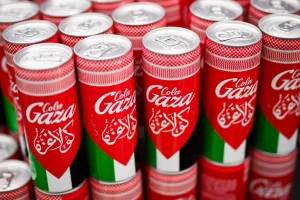
Qashoo claims that all earnings from the drink will go toward renovating the maternity unit at al-Karama Hospital, northwest of Gaza City.
Gaza Cola joins other brands in increasing awareness about Palestine and calling for a boycott of big-name colas operating in Israel.
According to co-founder Mohamed Kiswani, Palestine Drinks, a Swedish firm that began in February, sells between 3 and 4 million cans of their drinks (one of which is a cola) per month. Founded in Jordan in 2008 as a local alternative to Coke and Pepsi, Matrix Cola operates its primary SodaStream factory in the Israeli-occupied West Bank and announced in January that its output has increased in recent months. Spiro Spathis, Egypt’s oldest carbonated beverage producer, experienced a significant increase in sales during their “100% Made in Egypt” promotion last year.
Consumer boycotts, according to Jeff Handmaker, an associate professor of legal sociology at Erasmus University Rotterdam in the Netherlands, aim to hold companies accountable by increasing awareness of corporate or institutional responsibility in atrocity crimes.
“In this regard, the campaign to boycott Coke is evidently successful,” Handmaker says.
Qashoo is already working on the next generation of Gaza Cola, which will have more fizz. Meanwhile, he believes that every sip of Gaza Cola raises awareness of Palestine’s suffering.
“We need to remind generations after generations of this horrible holocaust,” according to him. “It’s happening, and it’s been happening for 75 years.”
“It just needs to be a tiny, gentle reminder, such as ‘By the way, enjoy your drink, greetings from Palestine.'”