

Malaysia’s Immigration Reforms in 2025 Signal a Shift Toward Digital Control and Stricter Enforcement

KUALA LUMPUR: The Malaysian Immigration Department’s performance in 2025 reflects more than operational success; it signals a strategic recalibration of how the country manages borders, migration, and state authority in an era of rising mobility and security concerns.
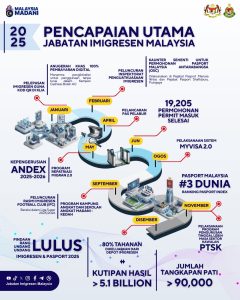
With revenue collections exceeding RM5.1 billion, the completion of 19,205 entry permit applications, and over 90,000 arrests of undocumented migrants, the year underscored a dual focus on economic efficiency and enforcement intensity. These outcomes suggest the department has moved decisively toward a data-driven, compliance-oriented immigration regime.
At the heart of this shift is digitalization. The introduction of cashless payments across all services, QR-code immigration clearance at KLIA, and the rollout of MYVISA 2.0 represent a deliberate attempt to reduce bureaucratic friction while tightening oversight. For policymakers, the emphasis on automation is as much about integrity and traceability as it is about speed and convenience.
The global ranking of the Malaysian passport as third strongest worldwide further reflects this transformation. While passport rankings are influenced by diplomatic access, they also mirror international confidence in a country’s documentation standards and border governance. In this sense, Malaysia’s rising rank strengthens its soft power and reinforces its credentials as a trusted travel partner.
Yet enforcement remains central to JIM’s identity. The arrest of more than 90,000 undocumented migrants (PATI) and the repatriation-focused release of 80% of immigration detainees reveal an approach that blends firmness with administrative rationalization. Rather than prolonged detention, the emphasis appears to be shifting toward faster processing and deportation, reducing costs and congestion in detention facilities.
Institutionally, the launch of the Immigration Enforcement Inspectorate and the implementation of the Andex Management Plan 2025 & 2026 point to a growing awareness that enforcement power must be matched with accountability. This comes amid longstanding public scrutiny over corruption, abuse of authority, and governance lapses within border agencies.
Legal reforms, including amendments to the Immigration and Passport Acts, provide the legislative backbone for these operational changes. Together with community-based initiatives and institutional branding under the Malaysia MADANI framework, the department is positioning itself not merely as a gatekeeper but as a modern administrative authority aligned with national reform goals.
However, challenges remain. High arrest figures raise questions about the sustainability of enforcement-heavy strategies, particularly in labor-dependent sectors of the economy. Similarly, the success of digital systems will depend on cybersecurity resilience, interagency coordination, and public trust.
Ultimately, the Immigration Department’s 2025 performance marks a transitional moment. It lays the groundwork for a more technologically advanced, rules-based immigration system, but its long-term success will be measured not only by numbers collected or arrests made, but by how effectively it balances security, economic needs, and human rights in the years ahead.