

New BRICS-Asean commission aims to deepen trade and economic ties
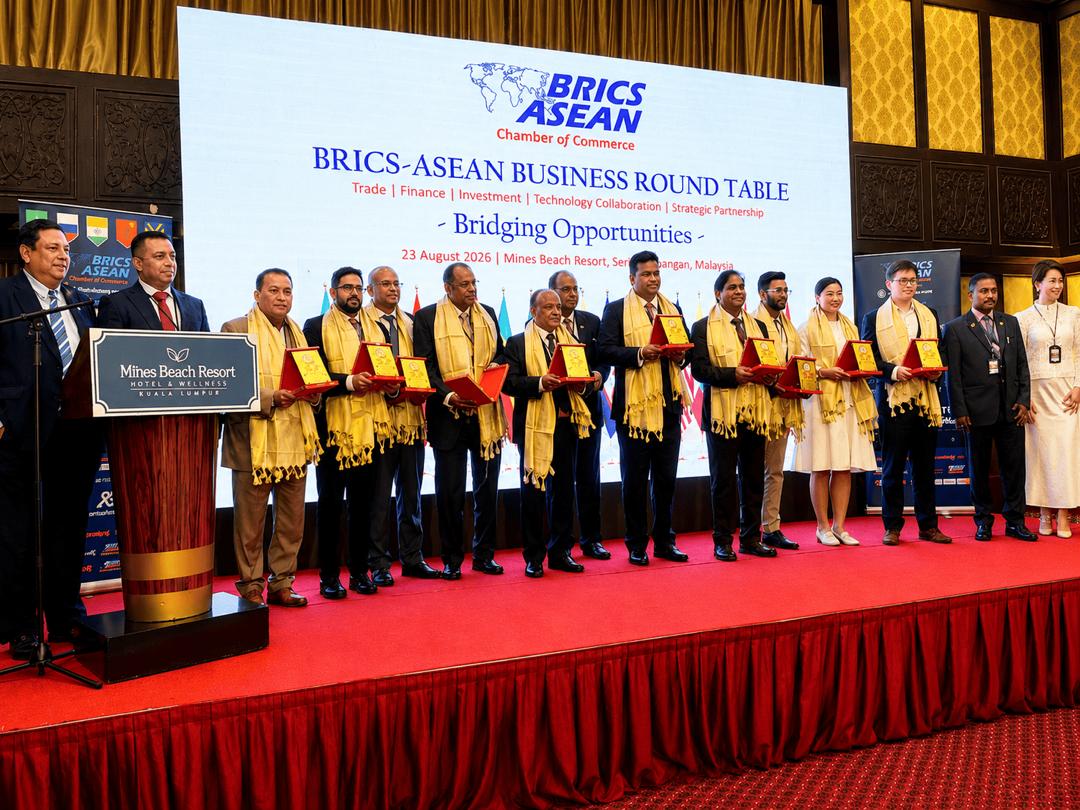
KUALA LUMPUR — A new independent commission is being established to deepen trade and economic cooperation between the BRICS and Asean blocs, as businesses look to build stronger links across emerging markets.
The BRICS-Asean Chamber of Commerce announced the initiative at the BRICS-Asean Business Round Table 2026 at Mines Beach Resort today, bringing together business leaders, diplomats and trade representatives to explore opportunities in trade, investment, tourism, technology and economic development.
Chamber president Thayalan Nathan said the commission would serve as a platform to strengthen economic ties between BRICS and Asean.
Details of its structure and mandate were not disclosed.
The initiative comes as businesses and policymakers increasingly seek to expand commercial links beyond traditional regional markets, with tourism, technology, education and investment emerging as potential areas for cooperation.
Malaysia International Tourism Development Association (MITDA) president Kapten Mahadzir Tan Sri Mansor said tourism should be viewed as more than an industry focused on bringing in visitors.
Instead, it should be regarded as an economic engine capable of generating activity across multiple sectors.
He challenged the conventional emphasis on tourist arrival numbers, saying the more important question was how much economic activity each visitor generated.
“One tourist is not one transaction,” he said, highlighting the ripple effects of visitor spending across airlines, hotels, restaurants, transport operators, retailers and technology companies.
Tourists could also return with family members, recommend destinations to others or potentially become business partners and investors, he added.
Mahadzir said tourism could therefore create a cycle in which demand drives business activity, trade and investment, ultimately generating employment and income.
Technology was becoming an increasingly important part of that ecosystem, with digital booking platforms, artificial intelligence, data, cybersecurity, digital payments, smart destinations and digital marketing transforming the tourism sector.
“Tourism connects the physical and digital economy,” he said.
Mahadzir also proposed the creation of a BRICS-Asean Tourism Bridge to connect the tourism ecosystems of both blocs.
The proposed initiative would go beyond linking destinations, bringing together people, cultures, businesses, markets, investors and technology companies.
He also proposed a broader BRICS Tourism Economic Alliance involving governments, tourism operators, businesses, investors, technology companies and small and medium-sized enterprises.
Under the proposed model, governments would create the necessary policy environment, industry players would develop products and experiences, businesses would generate commercial activity and investors would provide the capital needed to expand capacity.
Mahadzir said the objective should not simply be to increase tourist arrivals but to maximise the economic value generated by each visitor.
He also argued that tourism could contribute to wider regional cooperation, saying stronger people-to-people and business-to-business connections could eventually translate into greater trade and investment.
Mauritius High Commissioner to Malaysia Rabin Gungoo meanwhile said Mauritius could serve as a gateway for Malaysian businesses, investors and education providers seeking to expand into Africa.
Gungoo said around 3,000 Mauritian students were currently studying in Malaysia, reflecting the strong education ties between the two countries.
He encouraged more Malaysian universities and education providers to establish campuses in Mauritius, saying these could serve students not only from Mauritius but also from other African countries, including Madagascar and Seychelles.
Mauritius’ French- and English-speaking environment, he said, could also provide an advantage for businesses and students operating across different markets.
Gungoo urged Malaysian investors to explore Mauritius as a base for accessing wider African markets, pointing to the country’s existing trade links and arrangements with African countries.
Malaysia and Mauritius already trade in products including automotive goods, dried fruits and water, he said, adding that there was scope to expand bilateral trade further.
The discussions at the round table reflected a broader shift in how regional economic cooperation is being viewed, with tourism, education, technology, trade and investment increasingly seen as interconnected rather than separate sectors.
For Malaysia, the opportunity could extend beyond attracting tourists to using tourism and business connectivity as a platform for deeper economic engagement with BRICS, Asean and markets beyond the two blocs.
The business round table also featured networking and business pitching sessions aimed at facilitating potential partnerships among participating businesses and stakeholders.