

Iran Showcases ‘Active Diplomacy’ at SCO Summit in China
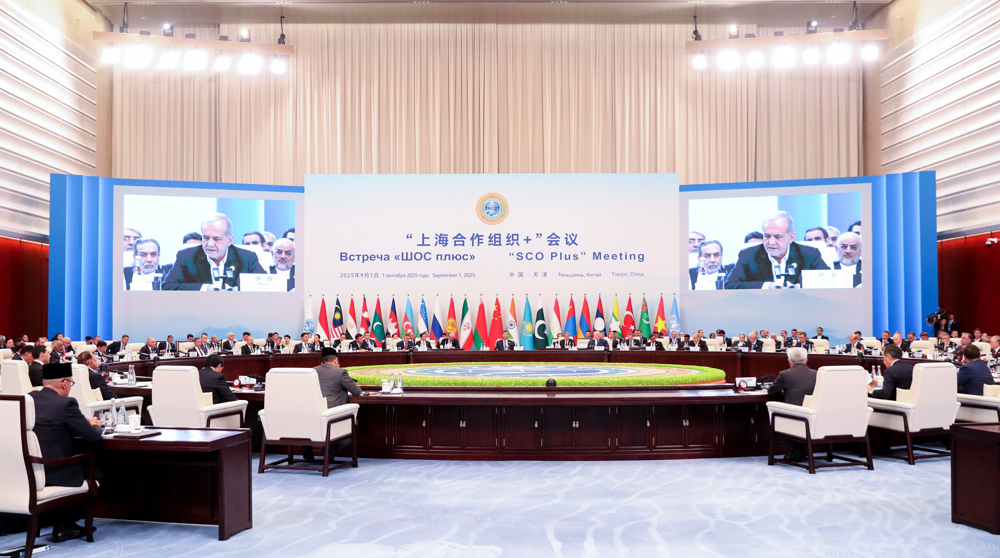
Beijing, September 3:A senior Iranian diplomat has praised the country’s pursuit of “active and multilateral” diplomacy following President Masoud Pezeshkian’s participation in the Shanghai Cooperation Organization (SCO) Summit in China.
Deputy Foreign Minister Kazem Gharibabadi said on Tuesday that the president’s presence and speeches at the summit highlighted Iran’s constructive role in advancing regional cooperation and global peace.
During the SCO meetings, President Pezeshkian put forward several initiatives, including the creation of a Peace-Building Committee made up of foreign ministers to address regional crises. He also suggested establishing an Accounts and Settlements Mechanism to strengthen financial cooperation and counter the effects of unlawful sanctions.
At the SCO Plus format, Pezeshkian emphasized Iran’s strategic position within China’s Belt and Road Initiative and expressed readiness to resolve issues surrounding its peaceful nuclear program through diplomacy. He also endorsed Chinese President Xi Jinping’s Global Governance Initiative, calling it a step toward promoting justice, equality, and multilateralism.
The summit concluded with the adoption of over 20 documents covering areas such as counterterrorism, narcotics control, artificial intelligence, green industry, sustainable energy, and multilateral trade.
In their final communiqué, SCO member states strongly condemned the “unprovoked war” launched by Israel and the United States against Iran in June, describing it as a violation of international law and the UN Charter. The members also reaffirmed the binding nature of UN Security Council Resolution 2231, which endorses the 2015 nuclear agreement, warning against arbitrary reinterpretations of the resolution.
The communiqué further acknowledged Iran’s initiatives, including proposals for a Strategic Security Studies Center, an industrial insurance union, and enhanced cooperation in new technologies and medicine supply chains.
On the sidelines of the summit, President Pezeshkian held high-level talks with leaders of China, Russia, Turkey, Pakistan, Tajikistan, and UN Secretary-General Antonio Guterres.
China’s President Xi Jinping described Iran as a strategic partner and called for deeper cooperation in transportation and connectivity.
Russia’s President Vladimir Putin reaffirmed commitments under the Iran–Eurasia free trade deal and praised growing bilateral ties.
Pakistan’s Prime Minister Shehbaz Sharif welcomed Pezeshkian’s recent visit to Islamabad, stressing Muslim unity in confronting Israel’s actions in Gaza.
Turkey’s President Recep Tayyip Erdogan opposed the reactivation of UN sanctions under the 2015 nuclear deal’s “snapback” mechanism.
Tajikistan’s President Emomali Rahmon emphasized historic ties with Iran and called for stronger economic and cultural cooperation.
UN Secretary-General Antonio Guterres said he was “personally convinced” that Iran’s nuclear program was peaceful and vowed to raise concerns with European states over potential sanctions reactivation.
Gharibabadi described Iran’s role at the summit as a “vivid display” of active diplomacy, signaling the Islamic Republic’s determination to engage constructively in regional and international affairs despite external pressures.