

Indonesian Haze Now Moving Transboundary Towards Singapore, Malaysia, Brunei
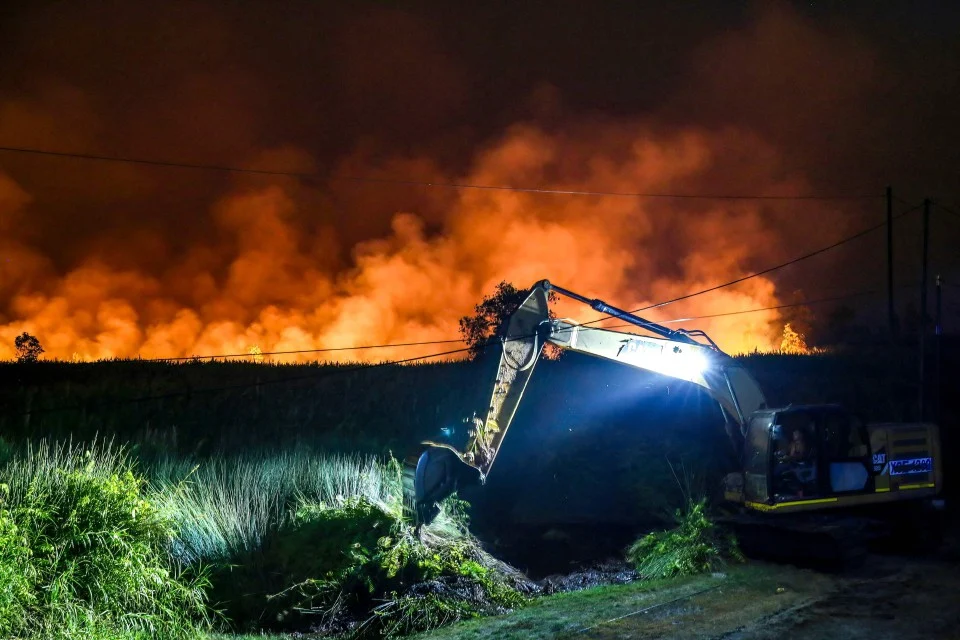
JAKARTA: Smoke from forest and land fires in Sumatra and Kalimantan is now moving towards the Straits of Malacca and the Natuna Sea.
This increases the risk of transboundary haze affecting Singapore, Malaysia, and Brunei.
Forecasts from Indonesia’s Meteorology, Climatology and Geophysics Agency (BMKG) since 29 August show that fine air pollutant particles PM2.5 from the fires are moving northwest.
The wind direction poses a risk of carrying smoke and these pollutants to the three neighbouring countries should weather conditions persist.
Acting Head of the Disaster Data, Information and Communication Centre at the National Disaster Management Agency (BNPB), Berton Panjaitan, said the haze situation remains serious in several areas in Kalimantan.
Visibility in three major affected regions in Kalimantan is only around one to 1.5 kilometres, compared to between 2.4 and five kilometres in affected regions in Sumatra.
Air quality in several areas of Kalimantan has also reached hazardous levels, with Central Kalimantan recording the highest increase from 876 to 5,391 hotspots, while West Kalimantan increased from 453 to 3,824.
However, the actual number of fire locations decreased in all three regions, to 56 in Central Kalimantan; 16 in West Kalimantan; and 52 in South Kalimantan.
In Sumatra, the number of hotspots decreased to 804 in South Sumatra; and 264 in Riau; but increased to 135 in Jambi.
Firefighting operations have also been stepped up in West Papua after 35 hotspots and eight fire locations were detected.
Fires in that region are estimated to have affected an area of 2,496 hectares, with visibility between five and nine kilometres.
The Indonesian government has also announced the temporary closure of climbing activities at nine national parks due to the high risk of forest and land fires in several of the country’s protected areas.
Indonesian Forestry Minister Raja Juli Antoni said the measure was taken to protect the safety of climbers, while allowing authorities to focus firefighting resources and assets in affected areas.
“There will be an official circular letter from the Director General of Natural Resources and Ecosystem Conservation (KSDAE), but I can announce the temporary closure of nine national parks,” he said.
Earlier, he attended a coordination meeting on forest and land fire management in Palembang, South Sumatra, on Monday.
According to him, fires occurring in several national parks have increased the burden on firefighting operations, forcing the government to redirect several water-bombing helicopters previously assigned to priority regions.
Among the national parks temporarily closed are Bromo Tengger Semeru National Park (Mount Semeru route), Kerinci Seblat National Park, Mount Ciremai National Park, Mount Tambora National Park, and Manusela National Park.
Also closed are Bukit Baka Bukit Raya National Park, Mount Gede Pangrango National Park, Mount Leuser National Park, and Lorentz National Park (Ilaga, Tsinga, Sugapa and Ugimba routes).
Raja Juli referred to the fire incident at Bromo Tengger Semeru National Park which left approximately 170 climbers trapped before being successfully rescued.
At the same time, several conservation areas remain partially open with strict monitoring and only involving zones deemed safe.
These include Mount Rinjani National Park, Mount Merbabu, the Hyang Plateau Wildlife Reserve (Mount Argopuro), and Mount Halimun Salak National Park.
As of the statement made on Monday (31 August 2026), Indonesia’s Forestry Ministry did not specify an end date or duration for the closures.
Raja Juli said the announcement was made as early notice to the public, while the official circular letter would be issued later.
The closures took effect from the announcement on 31 August and remain in force until further notice, subject to forest and land fire risk assessments by Indonesian authorities.
AGENSI