

Humanoid Robots Steal the Show as China Flaunts AI Power at Shanghai Expo
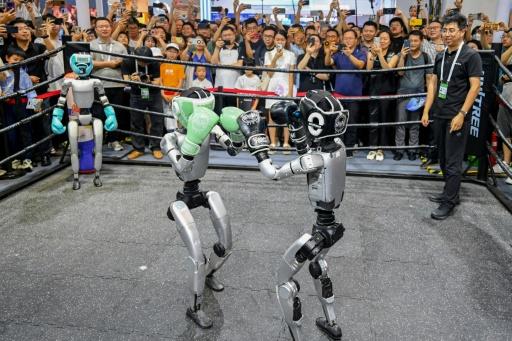
SHANGHAI: From pouring craft beer and boxing to playing mahjong and working assembly lines, humanoid robots dazzled thousands of visitors at this year’s World Artificial Intelligence Conference (WAIC) in Shanghai, providing a striking display of China’s growing ambition to lead the global AI race.
The annual WAIC, which opened this weekend, is China’s premier AI showcase, featuring over 800 companies and more than 3,000 cutting-edge products. Among the biggest crowd-pullers were the lifelike humanoid robots, many of which stunned onlookers with their slightly clumsy yet impressively human-like performances.
At one booth, a robot drummer kept time almost to Queen’s We Will Rock You, while in another, robots served drinks, boxed in exhibition rings, or competed in games of curling with human visitors. Although some machines still moved awkwardly, their year on year advancement was evident.
“Demand is currently very strong whether in terms of data, model training, or applications. The overall atmosphere is extremely vibrant,” said Yang Yifan, R&D director at Shanghai-based AI platform Transwarp.
China’s push into artificial intelligence has accelerated in recent years, bolstered by strong government backing and a clear goal: to match and ultimately surpass the United States in both AI innovation and regulation.
During the conference’s opening address, Premier Li Qiang announced the formation of a new organization focused on AI governance. He emphasized the importance of balancing innovation with the risks associated with powerful new technologies.
Still, the mood on the expo floor was upbeat. Attendees flocked to booths hosted by top AI firms like Baidu and Unitree Robotics, with the latter showing off its G1 android, a 130 cm tall humanoid capable of kicking, punching, and maintaining balance in real-time. Unitree also revealed plans to release a full-size humanoid robot, the R1, priced under $6,000 a potential game-changer for accessibility.
In the meantime, Baidu revealed improvements to its “digital human” technology, including hyper-realistic AI avatars that are capable of livestreaming, thinking, and teamwork. In several categories, a recent e-commerce stream featuring a well-known influencer’s Baidu-generated avatar beat the human’s own sales debut. More than 10,000 businesses are reportedly already using the company’s digital human tools.
The conference is the first since a major breakthrough in January, when Chinese startup DeepSeek launched an AI model that rivaled leading U.S. systems at a fraction of the cost. The achievement fueled a new wave of confidence in China’s tech sector.
Despite concerns about job displacement and ethical risks, Chinese tech leaders remain optimistic.
“AI is a tool to improve quality, save time, and reduce workload. It still needs human oversight,” said Wu Chenxia, head of Baidu’s digital human division.
Visitors to WAIC seemed more fascinated than fearful, capturing selfies with robots and marveling at dancing dog-bots and back-flipping androids. With abundant data, vast real-world testing environments, and strong state support, China’s AI ecosystem appears poised for further rapid expansion.
“China has a good data foundation and many real-world application scenarios,” said Transwarp’s Yang. “There are countless opportunities for experimentation here.”