

Erdogan Urges Restraint Between Russia and Azerbaijan Amid Rising Tensions
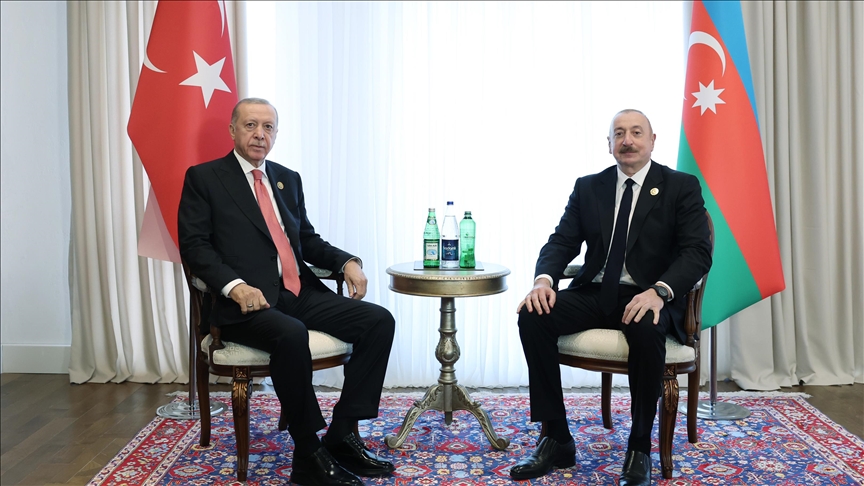
ISTANBUL||July 5 : Turkish President Recep Tayyip Erdogan has called for calm and diplomatic resolution between Russia and Azerbaijan amid rising tensions that Ankara fears could destabilize the broader region.
Speaking to reporters on his return flight from Azerbaijan, Erdogan underscored Türkiye’s close ties with both Moscow and Baku, stressing the importance of avoiding any actions that could cause “irreparable damage” to bilateral or regional relations.
“Both countries have the wisdom and maturity to overcome these challenges,” Erdogan said, reaffirming Türkiye’s commitment to support constructive and diplomatic solutions to the dispute.
Zangezur Corridor: A “Geo-Economic Revolution”
Addressing the peace agreement between Armenia and Azerbaijan, Erdogan said the finalized deal—reached after talks in Brussels, Moscow, and Tbilisi in late 2024—presents historic opportunities for regional integration.
A key component of the deal, the Zangezur Corridor, will connect western Azerbaijan to the Nakhchivan exclave and link with Türkiye’s railway network, facilitating trade routes from China to Europe via Central Asia and Türkiye.
“The corridor represents a geo-economic revolution,” Erdogan stated. “It will benefit not only Azerbaijan but the entire region.”
Erdogan noted that while Armenia initially opposed the project, it is now showing greater flexibility toward economic integration. He also emphasized the strategic synergy between the Zangezur Corridor and the Middle Corridor, a broader trade route connecting China and Europe through Türkiye.
Defense and F-35s
On defense matters, Erdogan commented on Türkiye’s ongoing initiatives within NATO and addressed Greece’s concerns about Ankara’s defense posture.
“We pose no threat to any nation that does not threaten us. Our efforts are focused on contributing to NATO’s collective security,” Erdogan said.
He also discussed the long-standing F-35 fighter jet dispute with the United States, expressing hope that deliveries would resume during Donald Trump’s presidency, citing past commitments.
“This is not just about military aircraft. It’s about building strategic partnerships that strengthen NATO and global security,” Erdogan added.
He noted that setbacks in the F-35 program have pushed Türkiye to make rapid advancements in its domestic defense industry, turning a diplomatic challenge into a strategic opportunity.
Israel, Gaza and U.S. Mediation
Turning to the Middle East, Erdogan criticized Israel’s ongoing attacks and violations of ceasefire agreements. He said Türkiye is actively working to prevent a recurrence of violence and pointed to Iran-Israel ceasefire developments as a possible opening for a broader truce in Gaza.
“I urged President Trump to intervene directly with Prime Minister Netanyahu,” Erdogan recalled, citing a conversation during the recent NATO Summit in The Hague.
He revealed that a 60-day temporary ceasefire plan is now under consideration, with U.S. pressure on Israel playing a critical role.
“This is a decisive moment. The U.S. and other Western powers must intensify their pressure on Israel to agree to a lasting ceasefire,” he emphasized.
Türkiye’s Position on Syria
On Syria, Erdogan reiterated Türkiye’s red lines, firmly rejecting any moves that would legitimize terrorist groups or their affiliates. He reaffirmed Ankara’s support for a unified Syrian state with control restored to the Syrian Army.
“We aim to eliminate terrorism, dismantle armed factions, and enable Syrian state authority across its territory,” he said.
Erdogan proposed future economic cooperation in northern Syria, including logistics hubs, free trade zones, and cross-border markets, to aid post-conflict development.
He also welcomed the recent lifting of sanctions by the U.S. and Europe, suggesting that it would help accelerate Syria’s reconstruction process.
Erdogan added that Azerbaijani President Ilham Aliyev has offered support for natural gas supply to Syria as part of a broader plan for regional stabilization and development.