

Around 100,000 Palestinians Gather at Al-Aqsa for Second Friday of Ramadan Amid Tight Restrictions
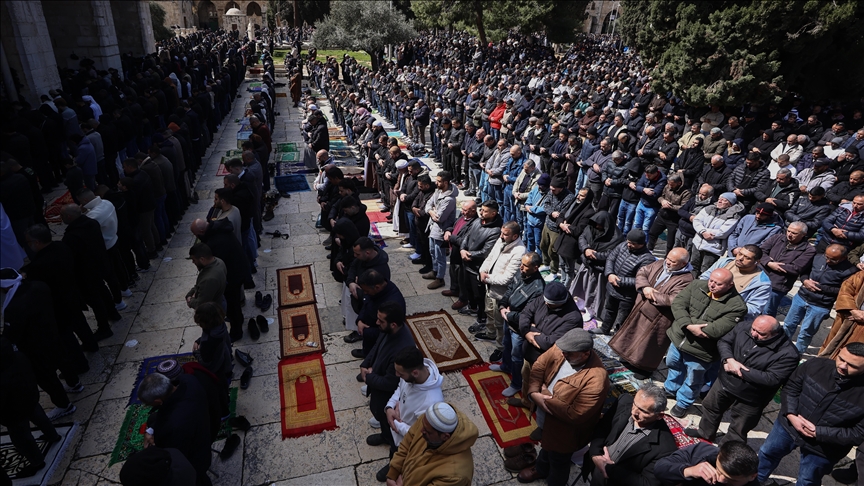
JERUSALEM / ISTANBUL: Approximately 100,000 Palestinian worshippers performed Friday prayers at Al-Aqsa Mosque during the second week of Ramadan, despite heightened Israeli security measures and movement restrictions, according to Palestinian religious authorities.
Sheikh Azzam al-Khatib, director general of the Palestinian Ministry of Endowments and Religious Affairs, said the turnout reflected the determination of worshippers to attend congregational prayers at the revered site. The mosque compound, located in Jerusalem’s Old City, is considered one of Islam’s holiest places.
Witnesses reported a significant deployment of Israeli police forces throughout the Old City of Jerusalem, including at entry points, surrounding neighborhoods, and the outer gates of the mosque compound. Israeli authorities confirmed that thousands of officers were stationed across East Jerusalem as part of security arrangements.
Despite the visible security presence, worshippers began arriving at the mosque before dawn. However, many Palestinians from the occupied West Bank were unable to reach Jerusalem after being stopped at military checkpoints. Israeli authorities have maintained strict entry requirements, allowing only limited numbers of permit holders to pass.
Thousands reportedly gathered at the Qalandia checkpoint north of Jerusalem in hopes of entering the city for prayers. Some worshippers said they were turned back after being informed they did not meet pre-set security conditions.
At the start of Ramadan, Israel announced that entry for Friday prayers would be capped at 10,000 West Bank Palestinians throughout the holy month, citing security recommendations. Last week, around 80,000 worshippers attended the first Friday prayers of Ramadan at the mosque compound. While this week’s attendance increased to roughly 100,000, it remains below pre-war levels, when more than 150,000 people typically gathered.
Ramadan has traditionally drawn large crowds from across the West Bank to Jerusalem, filling the mosque compound and contributing to increased commercial activity in the city’s markets.
Since the outbreak of the Gaza conflict in October 2023, Israeli authorities have maintained heightened movement controls around Jerusalem. Entry into the city generally requires special permits issued by the Israeli military, which many Palestinians say are difficult to obtain.
The status of Jerusalem remains one of the most sensitive and contested issues in the Israeli-Palestinian conflict. Palestinians view East Jerusalem as the capital of a future independent state, while Israel considers the city its unified capital.