

EU-Iran talks in Geneva give people hope for peace in the midst of war, but they don’t lead to a breakthrough.
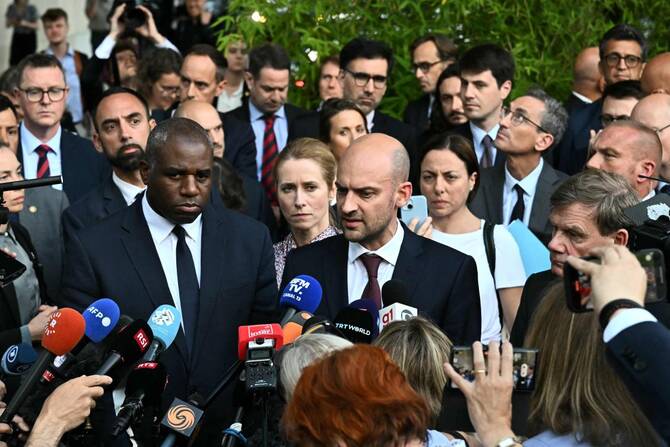
June 21, Geneva— On Friday, Iranian Foreign Minister Abbas Araghchi met with his European counterparts at a high level. The meeting ended with a glimmer of hope for continued diplomatic engagement, but no instant progress was made in ending the crisis over Iran’s nuclear program or the conflict with Israel.
The foreign ministers of the UK, France, and Germany, who are known as the “E3,” met with Araghchi at a hotel in Geneva for almost three and a half hours. The meeting was also attended by Kaja Kallas, who is in charge of foreign policy for the EU. It was the first time that Western and Iranian leaders had met in person since Israel and Iran went to war a week ago.
Officials said the talks were “serious” and helpful, but no major progress was made.
“The good thing about today is that we leave the room with the impression that the Iranian side is ready to keep talking about all the important issues,” said Johann Wadephul, the German foreign minister.
David Lammy, the foreign secretary of Britain, said, “We are eager to continue discussions and negotiations with Iran, and we urge Iran to continue their talks with the United States.” He also said, “We made it clear: Iran cannot have a nuclear weapon.”
Jean-Noël Barrot, the foreign minister of France, said that negotiation is still the only way to solve the problem.
“Operations in the military can slow down Iran’s nuclear program, but they can’t stop it,” Barrot said. “After Afghanistan, Iraq, and Libya, we know very well how risky and pointless it is to try to change a government from the outside.”
Barrot said Araghchi was open to discussing new issues and having larger talks, even with the US.
Kaja Kallas, the head of foreign affairs for the EU, confirmed that the participants agreed to deal with both the nuclear issue and bigger problems in the area. She said, “We will keep the talks going.”
The response from Iran was condemnation and cautious optimism.
When Araghchi talked to reporters after the meeting, he said it was a “grave concern” that Europe had not spoken out against Israel’s attacks on Iran’s nuclear infrastructure. He said again that Iran was ready to keep speaking with the E3 and the EU and hinted that they could meet.
“We support keeping the talks going,” he said. “However, we expect everyone to proceed in a balanced and fair manner.”
The US thinks about what to do next.
The Geneva talks happen at a time when Washington is having many discussions. This week, British Foreign Secretary Lammy met with U.S. Secretary of State Marco Rubio and Steve Witkoff, who is President Trump’s Middle East ambassador.
Trump is thinking about whether to allow military strikes against Iran, focusing on the highly protected Fordo site for uranium enrichment. Deeply buried in a mountain, the site is believed to be beyond the reach of regular weapons. To reach the site, special bunker-busting bombs are required.
Trump has said that a choice will be made in two weeks. This is because the U.S. is thinking about the possibility of starting talks with Iran again. The president had earlier said that there was a 60-day window for peace talks, which he says ended right before Israel started its airstrikes.
A Wrong Start for Diplomacy
Despite the escalating tensions and ongoing military conflict, European leaders appear eager to maintain open communication with Iran.
Barrot said again, “There is no final solution by military means.” “Only diplomacy can lead to a long-term solution.”
The Geneva meeting ended without agreements, but both sides said they want diplomacy. This is a small but important chance to stop the situation from getting worse and maybe bring the Iran nuclear issue back into a framework where it can be discussed.