

Energy Asia 2025: Asia’s Voice in Energy Transition and Security
KUALA LUMPUR, 18 June 2025 – Energy Asia 2025 has emerged as a critical platform for shaping the region’s energy future, spotlighting Asia’s growing leadership in the global energy transition. Now in its second edition, the conference gathered nearly 3,000 delegates from 60 countries, catalyzing high-level conversations around energy security, sustainability, and innovation.
At a press conference, Tan Sri Tengku Muhammad Taufik, President & Group CEO of PETRONAS and Chairman of Energy Asia, spoke about the importance of long-term energy investments that transcend political cycles to ensure stable energy supply.
“Energy Asia aims to serve as the distinct ‘voice of Asia’ in the energy conversation, moving away from a traditionally North-West Europe-dominated narrative,” he said.
The rapid rise in regional energy demand, with Malaysia alone seeing a 6.5% surge in electricity needs, underscores the urgency for solutions tailored to Asia’s unique challenges.
AI Surge and Gas Demand Reshape Outlook
The conference also highlighted how the rise of artificial intelligence and data centers is intensifying energy consumption, particularly electricity and natural gas. This growing demand has triggered Malaysia to explore the possibility of becoming a liquefied natural gas (LNG) importer, with a third regasification terminal already in the works.
A key theme was the complex “polycrisis” facing energy producers—ranging from harder-to-access reserves and rising carbon costs to geopolitical instability and volatile energy systems.
Malaysia is also considering introducing a carbon tax by 2026, with a regional push for harmonizing carbon pricing to facilitate investment and combat climate change effectively.
Sustainability Leaders Address Nature, Economy, and Energy
Senior executives from PETRONAS, Shell, and the University of Tokyo addressed the convergence of climate, biodiversity, and corporate responsibility during the plenary titled “Sustainability Leaders Navigating Geopolitical and Economic Shifts.”
Charlotte Wolff-Bye, PETRONAS’ Chief Sustainability Officer, launched the Energy and Nature Forum, reinforcing the importance of embedding biodiversity in energy transition strategies. Malaysia, home to one of the world’s oldest rainforests, provided a powerful backdrop for this initiative.
“Renewable energy infrastructure must not harm the ecosystems it seeks to preserve,” she stressed.
Dr. Naoko Ishii of the University of Tokyo highlighted that nature loss directly affects nearly half of global GDP, calling for economic systems to account for natural capital. Meanwhile, Shell’s Karen Westley shared real-world operational gains—such as reducing single-use plastics offshore—and reaffirmed Shell’s dual focus on emissions cuts and social value.
The panel collectively underscored the growing importance of chief sustainability officers as drivers of business value, not cost centers, especially amid increasing geopolitical risks.
Upstream Innovation in a Carbon-Constrained World
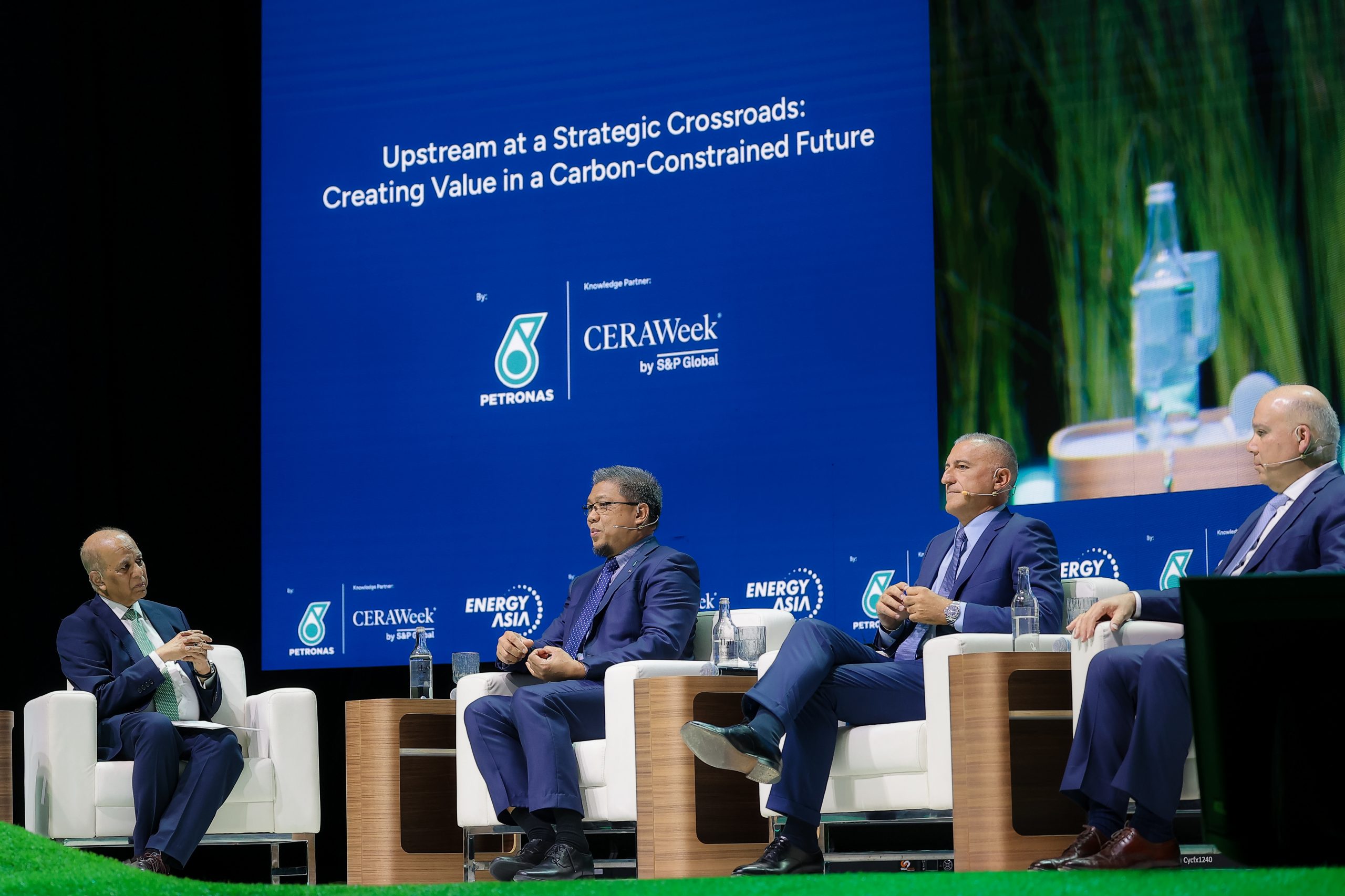
The upstream sector’s response to climate and economic pressure was discussed during the plenary session titled “Upstream at a Strategic Crossroads.” Chaired by Dr. Atul Arya of S&P Global, the session featured leaders from PETRONAS, Eni, and Baker Hughes.
PETRONAS’ Mohd Jukris Abdul Wahab shared how the company is focusing on gas prioritization, which now makes up 78% of its portfolio, alongside divestments and partnerships like those with Eni to reshape upstream assets with a sustainable edge.
Eni’s Guido Brusco introduced a model based on “advantaged barrels”—resources that are geographically favorable and infrastructure-adjacent. Eni is also investing heavily in CCS, biorefineries, and fast-track project execution (cutting timelines to 3.5 years).
Baker Hughes’ Amerino Gatti presented the company’s latest innovations, including AI-driven predictive maintenance, autonomous drilling, and LNG-cycle integration, enabling cost reductions and operational efficiency.
All participants stressed the need for early collaboration, digitalization, and portfolio discipline to navigate the path to net zero.
Malaysia’s 2050 Net-Zero Target Gains Momentum
The ministerial plenary, chaired by Tan Sri Abdul Wahid Omar, reinforced Malaysia’s commitment to achieving net-zero emissions by 2050, focusing on inclusive, technology-driven, and resilient strategies.
Finance Minister II, Datuk Seri Amir Hamzah Azizan, stressed that meaningful decarbonization requires real economic reform, not just policy statements. Key initiatives include
- MYR 43 billion investment to upgrade the national grid
- Doubling renewable energy’s share in the mix from 8% to 16%
- Reforms to subsidies will precede the 2026 rollout of the carbon tax.
- Fiscal tools such as Green Investment Tax Allowances and green sukuk
Deputy Minister Akmal Nasrullah elaborated on the National Energy Transition Roadmap (NETR), which aims to expand solar capacity from 400 MW to 4,000 MW, scale hydrogen and energy efficiency solutions, and promote energy access across Peninsular and East Malaysia.
From an industrial policy standpoint, MITI Deputy Minister Liew Chin Tong noted Malaysia’s pivot from trade-centric to tech-centric growth. Through the National Investment Aspiration and Semiconductor Strategy, Malaysia seeks to attract green FDI and develop low-carbon industries.
With AI and data centers driving power demand, national planners are accelerating battery storage, grid flexibility, and cross-border integration via the ASEAN Power Grid.
Discussions even broached the potential role of nuclear power in achieving net-zero baseload requirements.
A Whole-of-Nation Approach
Energy Asia 2025 concluded with a strong call for a whole-of-nation approach to energy transition—one that combines bold investments, robust policy frameworks, grassroots engagement, and regional partnerships. The path forward for Malaysia and Asia at large lies in diversified energy sources, technological breakthroughs, and nature-based solutions, ensuring that economic growth and environmental stewardship go hand in hand.