

75 cases of baby dumping from January to September
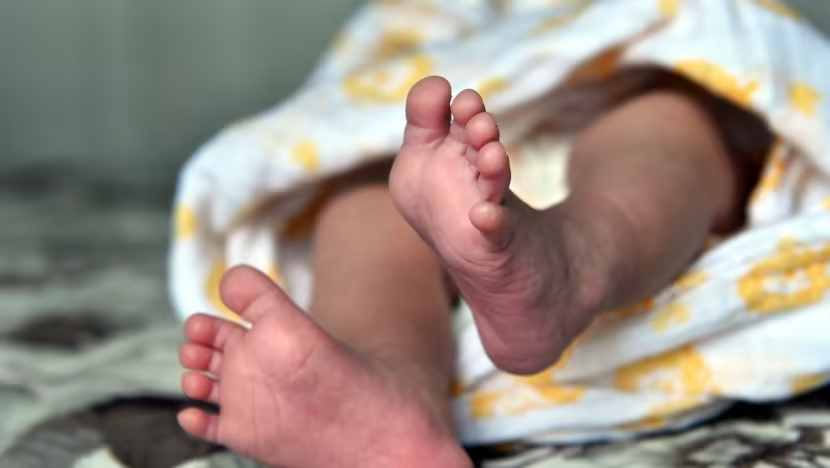
From January to September, police statistics reveal that there were 75 reported instances of newborn dumping across the country—up from 96 cases in the same period the previous year.
Additional information indicates that 48 of the 75 infants reported between January and September were discovered to be deceased, while 27 were rescued, according to Harian Metro.
In comparison, last year, 58 infants were discovered alive and 70 were discovered deceased, out of a total of 128 cases.
Selangor reported the most infant abandonment cases (21), followed by Johor (9) and Perak (8).
Selangor recorded the highest number of cases last year, with 38, followed by Sabah (21) and Johor (14).
The Penal Code and the Child Act 2001 guide the investigation of baby abandonment incidents in Malaysia.
The locations of infant abandonment cases in Malaysia typically include areas that are readily accessible, concealed, or less crowded.
The Assistant Director of the Sexual, Women, and Child Investigations Division of the Federal Police Criminal Investigation Department, SAC Siti Kamsiah Hassan, stated that residential areas, including playgrounds, back alleys, and the exteriors of neighbors’ residences, are the most frequently used locations for infant dumping.
Hospitals, clinics, mosques, public restrooms, markets, and rubbish receptacles are among the locations where infants frequently abandon themselves.
“Access to CCTV (closed-circuit television) in public areas and frequent patrolling helps identify high-risk locations,” said the representative.
Unfortunately, monitoring alone is insufficient to resolve this matter. The demand is for a change in societal attitudes toward out-of-wedlock pregnancies and for comprehensive support for mothers in crisis.
The stigma associated with out-of-wedlock pregnancies, according to Siti Kamsiah, is a fundamental factor that motivates individuals to resort to desperate measures, occasionally resulting in tragic outcomes.
“Stress, psychological pressure, and a lack of emotional support can push individuals to make irrational decisions, including abandoning their babies,” she asserted.
Particularly among adolescents who lack comprehensive sexual education, the pervasive exposure to explicit content and sexual elements on social media is another contributing factor.
According to her, the authorities were in favor of initiatives such as infant hatches, which offer safer alternatives for mothers in crisis to securely abandon their babies.
However, she insisted that one should not interpret baby incubators as endorsing promiscuity or unwed pregnancies.
“Advice is also provided to expectant mothers facing unplanned pregnancies to seek counseling from non-governmental organizations, the Welfare Department, or government hospitals as a preventive measure to avoid baby abandonment and encourage them to return to a life aligned with religious and cultural values,” she pointed out.
According to Siti Kamsiah, the Penal Code classifies baby dumping as a severe offense. Perpetrators are subject to stringent legal consequences, such as protracted prison sentences or substantial penalties.
By offering desperate individuals a safer and more humane alternative, the baby hatch initiative is perceived as a life-saving measure that offers a second chance for abandoned infants.
Specially designed spaces known as “baby hatches” enable mothers to discreetly and securely abandon their infants there.
They are equipped with detectors that notify personnel immediately upon placing an infant inside. The rescuers then place the rescued babies in suitable institutions or adoption programs.
Chief executive officer Nor Aidil Ikram Muhamad of KPJ Seremban emphasized that the infant hatch initiative should not be interpreted as a promotion of illicit behavior but rather as an endeavor to save lives.
“Our objective is to save infants without any form of bias.” He believes that leaving the infant safely in this location, rather than abandoning it, is the most critical aspect.
He claims that since 2013, the newborn protection center at KPJ Seremban has spared ten infants, one of whom had an HIV diagnosis.
He informed us that hospitals conduct health evaluations on rescued infants before transferring them to the Welfare Department. The Welfare Department works in partnership with the OrphanCare Foundation to match the infants with eligible adoptive families.
According to Zakiah A. Rahman, the general manager of the Foundation, the issue of infant abandonment requires a comprehensive approach rather than just punitive measures.
“The community must come together to provide support and assistance to those facing unplanned pregnancies to prevent desperate actions,” according to her.
Through eight baby chambers throughout Malaysia, the NGO has rescued more than 600 infants since the initiative’s inception in 2008.In addition, OrphanCare provides specialized support programs for mothers who are experiencing unintended pregnancies.
These programs provide guidance from the early stages of pregnancy, including the establishment of antenatal records, the provision of pre- and postnatal care, and the provision of infant essentials until the child reaches one year of age.
“We always advise these mothers to think realistically and prioritize their child’s welfare,” Zakiah added.
Dr. Farhana Sabri, a senior lecturer in counselling at Universiti Sains Islam Malaysia (USIM), has noted that despite initial misunderstandings, the infant hatch initiative has been beneficial in preserving the lives of innocent babies.
She stated, however, that infant chambers are only one component of the solution. Raising public awareness to prevent immoral behavior that results in such situations is equally critical.
She stressed the importance of adoptive families fully dedicating themselves to the emotional and physical upbringing of these children to avoid the perception or labeling of them as “abandoned.”