

Potential Middle East repercussions of the US election
Both major political parties are under increasing pressure to meet Muslim-American voters' concerns as the November elections approach
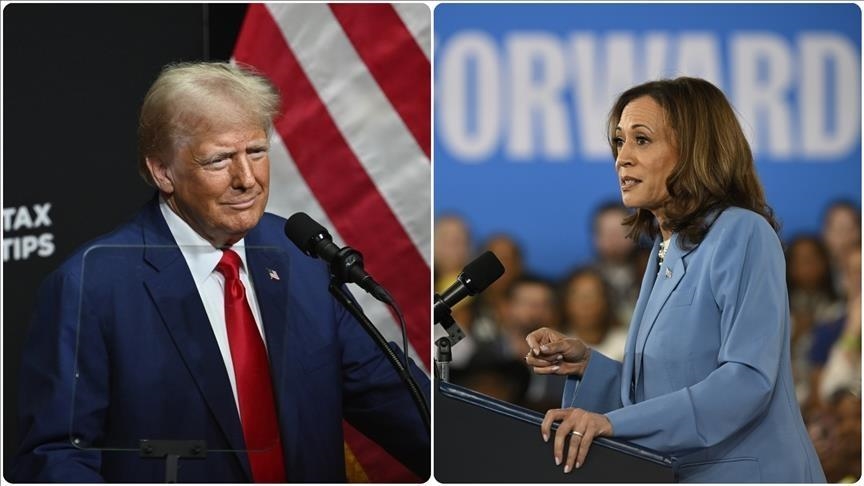
Israel’s prime minister was so happy with Donald Trump’s previous presidency that he named a neighborhood after him.
A towering statue of an eagle and a menorah stands watch above the entrance gate of Trump Heights, a remote community of prefabricated homes in the rocky, mine-strewn Golan Heights. At the horizon, mauve mountain peaks rise out of the blue sky.
This was Trump’s prize for acknowledging Israel’s territorial claims to the Golan, which it had unilaterally annexed after capturing it from Syria during the 1967 war, upending half a century of US policy and broad international agreement.
Two dozen families and a few billeted soldiers live there, and they are wondering what effect Republican nominee Trump or Democratic opponent Kamala Harris would have on Israel’s current regional interests.
For the safety of a tiny rural village, Elik Goldberg and his wife Hodaya relocated to Trump Heights with their four kids.
They have seen Israel’s battle with Hezbollah, a Hamas ally, intensify along the northern border with Lebanon, ten miles distant, since the Hamas assaults in southern Israel on October 7 of last year.
“Our lovely green open space has been filled with smoke for the past year, and our beautiful view is a view of rockets that Hezbollah is sending to us,” Elik remarked. “We have no idea when the war will end, and this is a war zone.”
According to Elik, he wants the incoming US government to “do the right thing.” “Support Israel,” he says when I inquire what that means.
He advises, “Have a common sense of right and wrong and support the good guys.”
It is the type of language that is frequently used in Israel. Additionally, Trump is familiar with this type of discourse.
During his final term as US president, he gained the support of Israeli leader Benjamin Netanyahu by rejecting a nuclear agreement with Iran that Israel opposed, negotiating historic normalization agreements with a number of Arab nations, and acknowledging Jerusalem as Israel’s capital—all of which went against decades of US policy.
He was previously referred to by Mr. Netanyahu as “the best friend Israel has ever had in the White House.”
The Israeli leader has made no secret of his admiration for the Republican nominee as America gets ready to cast its ballot, and surveys indicate he is not alone.
Recent polls show that over two-thirds of Israelis would prefer to see Trump return to the White House.
It seems that less than 20% of people support Kamala Harris’ victory. One poll claims that among Mr. Netanyahu’s own followers, that number falls to only 1%.
Gili Shmuelevits, 24, who shops in the Machane Yehuda market in Jerusalem, claimed that Ms. Harris “showed her true colours” when she seemed to concur with a rally protester who charged Israel with genocide. “He’s talking about something that’s real,” the vice president stated.
Later on, she made it clear that she didn’t think Israel was engaging in genocide.
Rivka declared that she was “100% for Donald Trump” while shopping nearby.
Israel is more important to him. He’s not afraid and he’s stronger than our adversaries,” she remarked. “I understand that he isn’t loved by everyone, but I don’t have to feel that way. I need him to support Israel well.
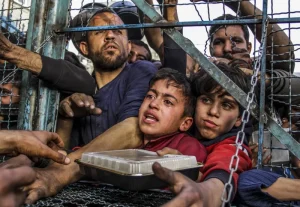
However, neither candidate inspires much hope among Palestinians.
“The general consensus is that the Democrats are bad, but it will be even worse if Trump is elected,” Mustafa Barghouti, a well-known Palestinian politician and commentator in the occupied West Bank, stated.
“The primary distinction is that Kamala Harris will be more aware of the change in American public sentiment, which means she will be more supportive of a ceasefire.”
US allies like Saudi Arabia have stepped up their pressure for progress toward a Palestinian State as a result of the Gaza War.
However, neither candidate has made the creation of a Palestinian state a top priority.
“I’d have to see,” Mr. Trump said in response to a question about whether he would support it during the presidential debates.
A lot of Palestinians have given up on the idea of a Palestinian state and, more generally, on American assistance.
According to Mustafa Barghouti, “the general feeling is that the US has failed drastically in protecting international law, has failed the Palestinians twice [and] took the side of total bias to Israel.”
“The Palestinian state issue is just a catchphrase.”
Trump reportedly advised Israel to “hit the nuclear first and worry about the rest later.” The two candidates have historically taken divergent stances on more general regional issues, such as Iran.
Before Israel launched attacks on Iran in retaliation for an Iranian missile attack earlier this month, he was speaking.
Former Israeli ambassador to the US Danny Ayalon stated that “it is easy to overstate the differences between the two candidates, but maybe Trump would play more hardball, and the Iranians would be more hesitant if he were president.”
Harris and Trump are currently discussing a new arrangement to prevent Iran from obtaining a nuclear weapon, and both seek to strengthen normalisation relations between Israel and neighboring Arab countries, particularly Saudi Arabia.
What would differ is their strategy.
“I think if it’s Kamala Harris [in the White House], the direction will be bottom-up,” said Danny Ayalon, implying that ceasefires in Gaza and Lebanon will be prioritized over larger issues such as Iran or new regional alliances.
According to him, about Trump, “the direction would be top-down – he will go straight to Tehran and from there, try to sort out all the different prongs and theatres throughout the Middle East” .
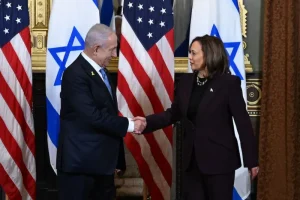
Political elites in Israel and the United States perceive Kamala Harris as more aligned with America’s longstanding bipartisan positions on Middle Eastern foreign policy, whereas Donald Trump is viewed as unpredictable, hesitant to involve America in foreign crises, and prone to ad hoc deal-making.
However, Ambassador Ayalon feels that policy is not the sole factor influencing Israel’s general mood.
“Biden stood by Israel for the entire year,” he told reporters. “But did not get his recognition [because of] things like not inviting him to the White House – things that are more optics than real issues.”
When it comes to US-Israeli ties, he believes that public gestures and emotions matter.
“Much of this is personal. The [common] interests are unquestionable, but the persons matter.”