

Asian Currencies Weaken on Hotter US Inflation; South Korean Stocks Plunge 8%
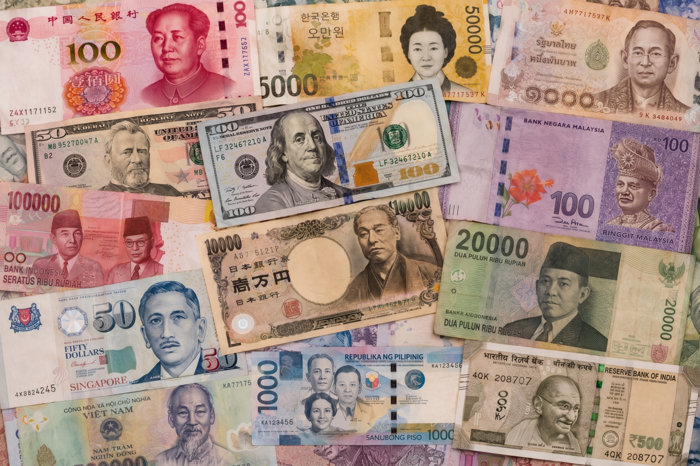
Emerging-market currencies face pressure as expectations of US Federal Reserve rate hikes strengthen the dollar, while Asian stock markets suffer broad losses.
Asian currencies weakened against the US dollar on Thursday as stronger-than-expected US inflation heightened expectations of further interest rate hikes by the Federal Reserve, while South Korean stocks plunged 8%, extending a sell-off across regional equity markets.
The Philippine peso hit a record low of 63.09 per US dollar, while the South Korean won fell 0.8% to a two-week low of 1,352.84 per dollar.
Taiwan’s dollar also declined sharply, touching its weakest level since early August at 32.320 per US dollar.
The pressure extended beyond Asia. Latin American currencies recorded their worst trading session in nearly two weeks overnight, with Brazil’s real falling 0.4% and Mexico’s peso declining 0.7%, although the Mexican currency recovered some ground during early Asian trading.
An MSCI gauge tracking emerging-market currencies fell 0.4%, marking its worst daily performance in two weeks.
The latest US data showed consumer prices rising faster than expected last month, strengthening expectations that the Federal Reserve could raise interest rates over the coming year, potentially as soon as this month.
Higher US interest rates typically support the dollar by making dollar-denominated assets more attractive to investors. This can put additional pressure on emerging-market currencies, encourage capital outflows from regional bond and equity markets, and increase borrowing costs for countries and businesses with dollar-denominated debt.
The US dollar index, which measures the greenback against a basket of major currencies, climbed to a fresh 18-month high following the inflation report. However, it surrendered most of those gains and was trading slightly lower by 0230 GMT on Thursday.
Asian equity markets also came under heavy selling pressure, led by South Korea, where stocks plunged 8%, putting the market on course for a seventh consecutive session of losses.
Shares of Samsung Electronics and SK Hynix, two of the world’s leading memory chipmakers, tumbled 10% and 12%, respectively. Both recorded their steepest daily declines since late July.
Taiwanese equities fell more than 3%, hitting a near one-month low. Taiwan Semiconductor Manufacturing Company (TSMC), the world’s largest contract chipmaker, also dropped around 3% to reach a one-month low.
Markets in Indonesia and Singapore each declined approximately 1%. Singapore’s stock market fell to a three-month low, with major lenders DBS Group and OCBC both losing around 1%.
Equities in Malaysia and the Philippines also edged lower, reflecting the broader weakness across emerging Asian markets.
The combination of persistent US inflation and expectations of tighter monetary policy has intensified pressure on emerging-market financial assets.
A stronger dollar and potentially higher US borrowing costs could make it more difficult for emerging economies to attract investment, while increasing the financial burden on borrowers exposed to dollar-denominated debt.
Investors are expected to remain focused on incoming US economic data and Federal Reserve policy signals as they assess the outlook for currencies, interest rates and stock markets across Asia.