

‘When the Red Light Comes On’
The 2026 US Open has introduced a new innovation, with red lights on the net posts serving as a visual signal whenever the Electronic Line Calling (ELC) system detects that a ball is out.
The innovation complements the ELC’s audio calls, helping players and spectators recognise decisions when the stadium becomes too noisy for the electronic call to be heard clearly.
For a start, the lights are being used at Arthur Ashe Stadium and Louis Armstrong Stadium, the tournament’s two main courts.
Once the ELC determines that a ball is out, the same signal is sent to the on-court equipment, causing the lights on the net posts to flash red almost immediately.
The lights, however, do not make the decision. They merely provide a visual indication of the ELC ruling.
The chair umpire remains responsible for officiating the match, while the lighting system uses the same trigger as the audio call and the indicator on the umpire’s chair.
US Open tournament referee Jake Garner said the innovation was introduced after organisers found that electronic audio calls were not always clearly audible, particularly during crucial points.
“When the stadium is noisy, the electronic call may not necessarily be heard by everyone,” he said.
The use of ELC has become increasingly widespread in professional tennis, reducing reliance on human line judges.
However, the technology has not been free from controversy, with several leading players questioning the accuracy of machine-generated decisions.
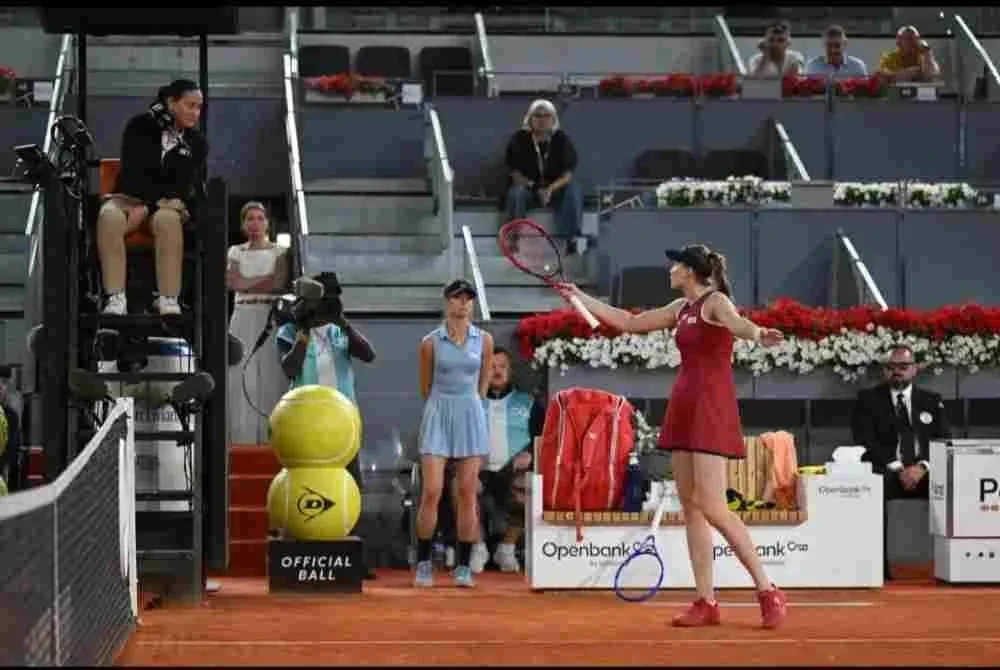
Elena Rybakina was among the most vocal critics following a controversial incident against Zheng Qinwen at the Madrid Open last April.
“The system is wrong. This is not a joke,” said the Kazakh player after claiming that the ball mark on the clay court did not correspond with the ELC decision.
Rybakina also questioned the umpire’s refusal to leave the chair to inspect the ball mark on the court.
“With a system like this, I will not trust it at all,” she said.
Alexander Zverev also disputed an ELC decision in Madrid after a ball he believed was clearly out was ruled in.
“The ball was way out, it wasn’t even close. They should change that rule,” said the German.
The controversies highlight how the challenge surrounding technology is not limited to the accuracy of decisions, but also extends to how those decisions are seen, understood and accepted immediately.
In that respect, the US Open’s red-light system offers a simple solution by allowing ELC decisions to be seen without players or spectators having to rely solely on audio calls.
Similar systems have also begun appearing at other tournaments, including the United Cup and Australian Open, where LED-equipped net posts light up when a ball is ruled out.
Wimbledon adopted a different approach in 2026, with scoreboards on all courts displaying ELC decisions such as “out” and “fault”.
These developments demonstrate the continuing evolution of tennis officiating, with technology being used not only to make decisions but also to communicate them more clearly to players and spectators.
Sinar Harian