

Malaysia needs stronger private capital ecosystem, wider exit pathways to unlock Asean opportunities
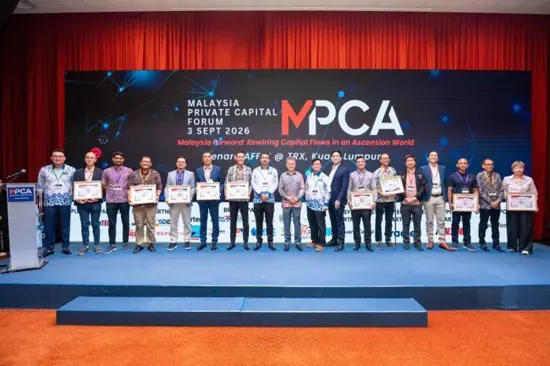
KUALA LUMPUR: Malaysia needs to strengthen its private capital ecosystem by deepening capital formation, expanding exit pathways and positioning itself as a gateway to Asean private markets, the Malaysia Private Capital Association (MPCA) said.
The call was made at the Malaysia Private Capital Forum 2026 here on Sept 3, which brought together investors, fund managers, founders, corporates, policymakers and ecosystem partners to discuss how Malaysia can attract and retain increasingly selective global capital.
Held under the theme “Malaysia Forward: Rewiring Capital Flows in an Ascending World”, the forum also highlighted the need for Malaysia to move beyond simply generating more deals and funds, towards building a stronger and more sustainable capital recycling ecosystem.
Deputy Finance Minister Liew Chin Tong, who was the chief VIP guest, said Malaysia was presented with its best opportunity since the 1997 Asian financial crisis to strengthen its economic position, develop solutions for businesses and create attractive investment opportunities.
“Malaysia is now in an excellent economic situation, and we must take this opportunity by developing solutions for businesses to flourish in the country,” he said in his keynote address.
Liew said the post-pandemic shift in the global economic model from efficiency to resilience had created strategic opportunities for Malaysia.
He noted that the economy grew six per cent in the second quarter of 2026, while first-half growth stood at 5.7 per cent, reflecting Malaysia’s resilience amid continuing global volatility.
Meanwhile, MPCA chairman Ng Sai Kit said global capital had not disappeared but had become increasingly concentrated, selective and demanding.
He said artificial intelligence accounted for 77 per cent of global venture deal value in the first half of 2026, highlighting the need for Malaysia to sharpen its value proposition and compete more effectively for global investment.
“Capital has not disappeared. It has become more concentrated, more selective and more demanding.
“Malaysia’s next chapter cannot simply be about creating more funds or generating more deals. It must be about building a stronger capital base, creating credible exits, returning capital to investors, and giving LPs the confidence to invest again,” he said.
Ng also pointed to the increasingly challenging fundraising environment in Asia.
APAC venture funds raised US$161.7 billion in 2021, compared with US$15.3 billion in the first half of 2026, underscoring the sharp shift in global capital conditions.
Against this backdrop, MPCA said Malaysia’s private capital agenda must focus on the entire capital recycling cycle — from LP capital and professional fund managers to investments, value creation, exits, distributions and reinvestment.
Malaysia recorded 22 venture deals worth approximately US$200 million in the first half of 2026.
However, MPCA said Malaysia should not seek to compete transaction-for-transaction with larger regional financial hubs. Instead, it should leverage its position as an investable base, an operating bridge and a source of companies capable of scaling across Asean.
“Don’t look at Malaysia only as a domestic market,” Ng said.
“Use Malaysia as a gateway into Asean private markets.”
The forum also highlighted the importance of developing credible exit routes and improving liquidity for private capital-backed companies.
Global mergers and acquisitions (M&A) activity reached US$1.3 trillion in the second quarter of 2026, with 42 per cent of the total value concentrated in just 34 transactions worth US$5 billion or more.
Corporate buyers accounted for US$893 billion of the activity, compared with US$287 billion from buyouts.
MPCA said Malaysia must develop stronger pathways for private capital-backed companies to scale and eventually exit, including through public market channels and a more vibrant M&A ecosystem.
The association has also advocated targeted M&A incentives to reduce transaction friction and encourage commercially viable consolidation.
“If we want LPs to allocate more capital to Malaysian private markets, we cannot only show them where their money will be invested.
“We must also be able to show them how that capital can eventually come back,” Ng said.
Looking ahead, MPCA identified its LP Agenda as a key priority for the next phase of the industry.
The association plans to deepen engagement with institutional limited partners (LPs), including pension funds, insurers, government-linked investment companies (GLICs), corporates and other capital allocators.
It will also seek to strengthen links with family offices, family capital and international investors.
Forum organising chairman Dr Chris Daniel Wong said MPCA would continue representing the industry’s interests while connecting capital with credible managers and investment opportunities.
He said the association would also focus on developing the standards, talent and institutional capabilities required for Malaysia’s private capital ecosystem to mature.
“In many ways, the work of the past decade has been about building Malaysia’s GP ecosystem.
“The work ahead must increasingly be about building Malaysia’s capital ecosystem,” he said.
Established in 1995, MPCA — formerly known as the Malaysian Private Equity & Venture Capital Association — comprises leading and active players in Malaysia’s venture capital and private equity industry.
Its mission is to promote and develop the venture capital and private equity industry while advocating policies that strengthen the environment for private capital activities in Malaysia.