

Australia and Papua New Guinea Sign Historic Pukpuk Defence Treaty to Strengthen Military Ties
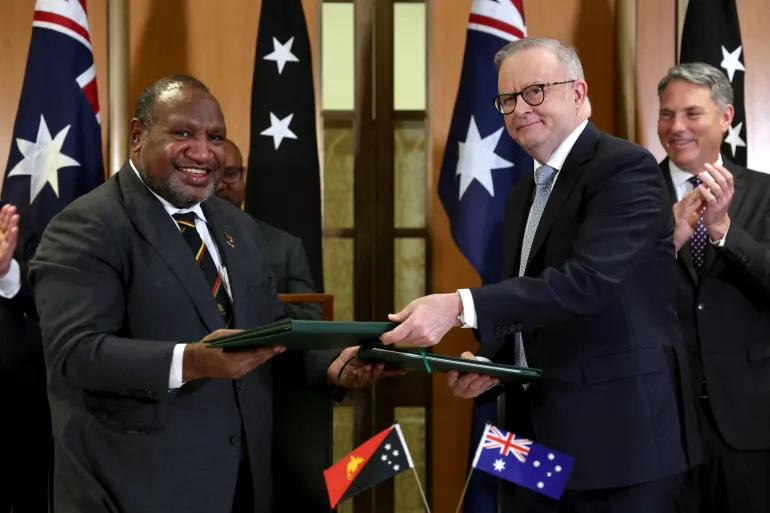
CANBERRA, Jan 18: Australia and Papua New Guinea (PNG) have formalized a mutual defense pact, signing the Pukpuk Treaty in Canberra, committing the two neighbors to enhanced military cooperation. The text of the treaty is expected to be released soon.
PNG Prime Minister James Marape told reporters that the agreement was “drawn up out of geography, history, and the enduring reality of our shared neighborhood,” emphasizing that it is about securing both countries like “one bigger fence that secures two houses.” Marape dismissed suggestions that the pact was motivated by broader geopolitical tensions, such as the military interests of China or the United States in the Pacific.
“This treaty was not conceived out of geopolitics or any other reason. We maintain friendships with all and advocate peace wherever we engage,” Marape said.
Australian Prime Minister Anthony Albanese highlighted that the treaty establishes clear “interoperability” between the defense assets of both nations and stressed that “our greatest asset is our people.” According to reports, the agreement could extend certain rights to PNG similar to those enjoyed by members of the Five Eyes intelligence alliance, which includes Australia, Canada, New Zealand, the United Kingdom, and the United States.
Marape’s office noted that the treaty will create pathways for 10,000 Papua New Guineans to serve in the Australian Defence Force, while PNG aims to expand its own military to 7,000 troops. PNG’s population is roughly 12 million, with about 40 percent living below the poverty line, contrasting sharply with its wealthier neighbor, Australia.
The Pukpuk Treaty comes weeks after PNG marked 50 years of independence from Australia, which had administered PNG as a colonial territory starting in 1902.
The agreement builds on prior cooperation, including a 2013 memorandum of understanding under which asylum seekers arriving by boat to Australia were detained on Manus Island, a facility that closed in 2017, leaving hundreds of refugees stranded.
Australia is also negotiating a security agreement with Fiji, following a stalled security and climate pact with Vanuatu, and recently signed a landmark climate displacement treaty with Tuvalu, allowing affected citizens to relocate through visa provisions.
Climate change remains a major security concern in the region, with Australia bidding to host the 2026 UN COP climate conference, alongside Pacific partners, though Turkey is also campaigning to host the event.
The Pukpuk Treaty signals a deepening of bilateral ties, reflecting a shared commitment to regional stability, defense cooperation, and people-to-people security partnerships in the Pacific.