

JD Vance Sparks Debate on Interfaith Marriage After Saying He Hopes Hindu Wife Converts to Christianity
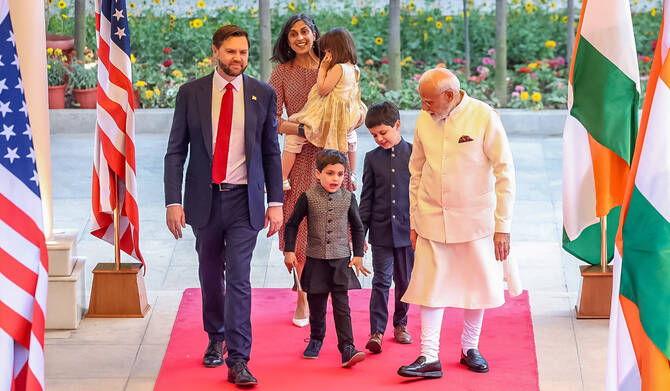
WASHINGTON, Nov 9: U.S. Vice President JD Vance has ignited a national debate over interfaith marriage after expressing his hope that his Hindu wife, Usha Chilukuri Vance, might one day convert to Christianity. His comments, made during a Turning Point USA event at the University of Mississippi, have drawn both criticism and reflection on the complexities of faith within modern relationships.
When asked how the couple raises their children given their differing beliefs, Vance responded candidly:
“Do I hope that eventually she is somehow moved by what I was moved by in church? Yeah, honestly, I do wish that… But if she doesn’t, then God says everybody has free will, and so that doesn’t cause a problem for me.”
The statement quickly drew backlash from Hindu advocacy groups, including the Hindu American Foundation, which accused Vance of perpetuating a long history of religious superiority and proselytizing. In a statement, the group said his comments “reflect a belief that there is only one true path to salvation, a concept Hinduism simply doesn’t share.”
Vance, who converted to Catholicism in 2019, five years into his marriage, defended his remarks on social media, saying that while his wife “has no plans to convert,” he continues to respect and cherish her faith.
“She is not a Christian and has no plans to convert,” Vance wrote on X. “But like many people in an interfaith marriage, I hope she may one day see things as I do. Regardless, I’ll continue to love and support her — because she’s my wife.”
Experts on interfaith relationships say Vance’s remarks highlight a sensitive issue many couples face. Susan Katz Miller, author of Being Both: Embracing Two Religions in One Interfaith Family, said successful interfaith marriages depend on respect and transparency.
“To respect your partner and everything they bring to the marriage — every part of their identity — is essential,” Miller said. “Having secret agendas is not a recipe for success.”
According to the Pew Research Center, 39% of Americans who married after 2010 have a spouse from a different religious background more than double the rate before 1960. Interfaith families today navigate complex decisions about faith, child-rearing, and identity in a far more pluralistic society.
At the Mississippi event, Vance said he and his wife decided to raise their children as Christians, with their eldest son recently completing his First Communion. Despite this, the couple incorporated Hindu rites into their wedding in 2014, reflecting their shared respect for each other’s heritage.
Religious scholars note that while Catholicism encourages raising children in the faith, it also prohibits coercion or pressure on non-Catholic spouses. John Grabowski, theology professor at The Catholic University of America, said:
“If your faith is central to your life, it’s natural to want to share it. But spouses must never be coerced. It’s a delicate balance.”
Interfaith counselors and advocates say that pressure to convert even unspoken can strain marriages. Dilip Amin, founder of InterfaithShaadi.org, advised that authentic faith should come from personal conviction, not spousal influence.
“If conversion happens because of genuine belief, that’s fine,” Amin said. “But if it’s due to pressure, it can destroy trust.”
Others, like Reverend J. Dana Trent, a Christian minister married to a Hindu monk, say interfaith marriages can instead be a source of spiritual growth.
“The goal isn’t to convert each other,” Trent said. “It’s to deepen understanding and support one another’s faith journeys.”
As Vance’s comments continue to reverberate, the controversy has sparked a broader conversation about love, faith, and respect in an increasingly diverse America one where interfaith families are both common and emblematic of the nation’s evolving spiritual landscape.