

Hamas Executes 32 Rival Fighters in Gaza City Amid Power Struggle After Ceasefire
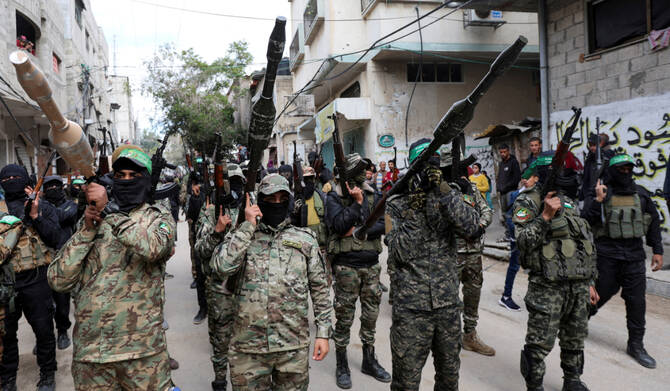
GAZA CITY, Oct 14: Hamas has killed at least 32 members of rival armed groups in Gaza City as part of a sweeping crackdown aimed at reasserting its control over the territory following a recently brokered ceasefire.
According to local security sources, the killings targeted members of a “gang affiliated with a prominent family” in Gaza City who were accused of defying Hamas authority. The clashes reportedly involved the powerful Doghmosh clan, long known for its uneasy relationship with Hamas. Six Hamas members were also killed in the operation.
Since the ceasefire took effect on Friday, Hamas has been gradually redeploying its Qassam Brigades fighters across Gaza, attempting to fill the power vacuum left after months of devastating conflict with Israel. The move marks the group’s effort to restore order in the war-torn enclave and, according to US President Donald Trump, may even have tacit American approval.
“They do want to stop the problems, and they’ve been open about it, and we gave them approval for a period of time,” Trump said while en route to the Middle East, hinting at a temporary green light for Hamas to act as a policing force until a new governance structure is in place.
Hamas officials confirmed that maintaining internal security is their current priority. “We will not allow a security vacuum,” said Ismail Al-Thawabta, head of Hamas’ government media office in Gaza. “Our duty is to protect public safety and property.”
The renewed Hamas presence came as its military wing, the Qassam Brigades, reportedly freed the last remaining hostages seized during the October 7, 2023, attacks, a key development in ongoing regional negotiations.
Washington’s postwar roadmap envisions Hamas relinquishing power in a demilitarized Gaza administered by a Palestinian committee under international supervision. The plan also includes deploying an international stabilization mission to train and support a new Palestinian police force.
However, despite international calls for disarmament, Hamas insists it will only surrender its weapons once a sovereign Palestinian state is established. The group has also claimed it does not seek a formal role in Gaza’s future administration but insists that Palestinians alone should decide their leadership.
Internally, Hamas faces mounting opposition from rival factions and clan-based groups, some allegedly backed by Israel. Israeli Prime Minister Benjamin Netanyahu previously stated that his government had “supported clans opposed to Hamas,” though he declined to name them.
In southern Gaza, anti-Hamas figure Yasser Abu Shabab, based in Rafah, has reportedly built a network of several hundred fighters. Hamas accuses him of collaboration with Israel, a charge he denies. A Gaza security official confirmed that Abu Shabab’s “right-hand man” was recently killed and that Hamas forces are actively pursuing Abu Shabab himself.
Meanwhile, Hussam Al-Astal, another anti-Hamas leader from Khan Younis, released a video mocking Hamas, claiming the group’s influence would end once it hands over the last hostages.
Palestinian political analyst Reham Owda told Voice of Malaysia News that Hamas’s latest actions are a warning to groups accused of collaborating with Israel. “By reasserting its security control, Hamas is trying to prove it remains a key power broker in Gaza and that its forces cannot be excluded from any future governing arrangement,” Owda said.
As the ceasefire holds tenuously, Gaza’s streets remain tense. The coming weeks may determine whether Hamas can successfully maintain its grip or whether new internal conflicts will erupt in the fragile postwar landscape.
— Voice of Malaysia News