

The Headline That Wounded Journalism’s Soul: Sarawak Tribune’s Misstep Against Anas Al-Sharif
By: Abdullah Bugis, (Journalist and Writer, based in Kuala Lumpur)
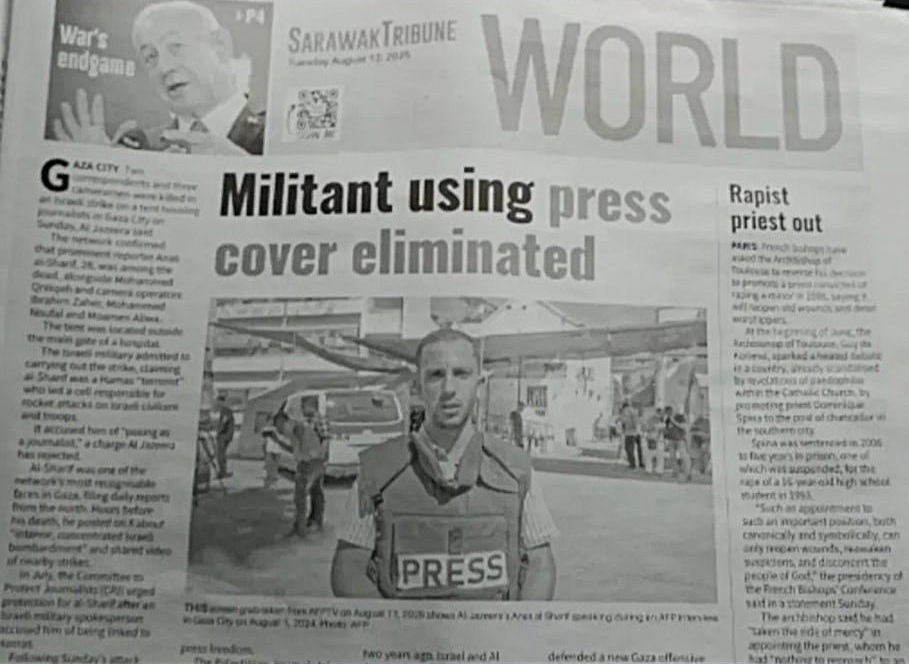
A news headline, like a sentry at the gates of truth, bears a sacred charge: to guard the reader’s trust and uphold the dignity of the craft. When it stumbles, the fall is never solitary—it pulls down with it the faith of the public and the honor of journalism itself. Such was the spectacle with Malaysia’s Sarawak Tribune, which in a moment of grievous misjudgment labelled slain journalist Anas Al-Sharif an “militant,” only to retract the slur and admit that its report had “did not meet the high standards of accuracy and clarity.” Yet the apology, though couched in formal contrition, was no mere procedural nod. It was an ethical reckoning, a mirror held up to both the newspaper and the broader Malaysian media, demanding they confront a question as raw as the conflict it sought to describe: how does one write of a war where the camera dies before the cameraman and still escape the lure of the pre-scripted narrative?
Anas Al-Sharif—a Palestinian journalist from Jabalia refugee camp, a field correspondent for Al Jazeera, and the son of a father killed in an earlier airstrike—walked each day into the jaws of Gaza’s siege and famine. Until the very hour of his death on 10 August 2025, he chronicled the anatomy of a blockade: flour sacks dwindling to dust in warehouses, nights stretched in unbroken darkness as the electricity bled away, and mothers storing water as though hoarding fragments of hope. Streets lay under the choking pall of pulverized stone; the sky, an unblinking vault, promised not rain but the arc of missiles.
Bearing Witness Through the Lens: In Gaza, Anas was not a fleeting name in a news ticker; he was the living pulse of a story until the day he became its headline. He fell alongside five Al Jazeera colleagues—Mohammed Qreiqa, Ibrahim Zahir, Mohammed Nofal, and Moamen Aliwa—and independent cameraman Mohammed Al-Khaldi when an airstrike shattered a press tent near Al-Shifa Hospital. Their lenses had spoken with a clarity words could seldom match; in an instant, they were silenced together, leaving cameras swaying in the air as if still framing the last image of a homeland inching toward erasure.
On 13 August 2025, Sarawak Tribune issued its statement of regret, conceding that certain phrases and sources in its report had fallen beneath the standards it professed to guard. It disavowed—“at all times and under any circumstances”—any allegiance to agendas that would imperil the rights of journalists or civilians, denied the adoption of Israeli narratives, and offered direct apology to the family, colleagues, and readers of Anas. It pledged sterner verification of sources, more rigorous editorial review, and specialized training for its newsroom on matters of heightened sensitivity. But the fracture in trust invites a question unsoftened by apology: can words once loosed and wounds once opened ever be fully mended?
A Nationally Sensitive Context: This controversy did not arise in a vacuum. It erupted in a Malaysia whose political conscience is sharply tuned to the plight of Palestine. The government of Prime Minister Anwar Ibrahim has been unambiguous in its opposition to forced displacement, in its call for an immediate ceasefire in Gaza, and in its pointed reservation over the “New York Declaration,” which proposed disarming Hamas and transferring Gaza’s administration to the Palestinian Authority. The Foreign Ministry has stood firm in rejecting any imposed settlement that would undermine the Palestinians’ legitimate rights.
Public sentiment has been no less resolute. Dr. Mohd Na’im Mokhtar, Minister in the Prime Minister’s Department for Religious Affairs, called for a mass rally for Gaza on 23 August, an appeal that met with an eager echo, following two years of vast street demonstrations bearing banners and demands: lift the siege, halt the bombardment, prosecute the guilty, and grant Gaza unimpeded humanitarian relief.
Scholarship has charted the depth and durability of this solidarity. A report by Singapore’s ISEAS, Yusof Ishak Institute, observes that Malaysia’s commitment to Palestine, rooted first in religious kinship, has matured into a domestic political emblem—an expression of national identity and a pillar of foreign policy. It notes Prime Minister Anwar’s steadfastness in advancing the Palestinian cause both in the streets and in diplomatic corridors, weaving it into the very fabric of Malaysia’s international posture. This, in turn, places the nation’s media at the confluence of two imperatives: to echo the moral voice of its people and to uphold the precision and discipline demanded by their trust.
The Word Before the Bullet: The death of Anas Al-Sharif and the Sarawak Tribune’s stumble expose the fragility of journalistic standards under the crush of urgency—and the enduring necessity of journalism as an instrument of justice rather than an accomplice to erasure. The images and chants that rippled through Kuala Lumpur’s streets and across its digital avenues were not transient sparks; they were proof that truth, when stripped of artifice, can traverse oceans from Malaysia to Gaza, and that a single honest image can breach a siege before any shell is fired.
In the final measure, the question belongs not to Malaysia’s press alone but to the conscience of the global media: do we dare to tell the story of Palestine as it is, rather than as it is handed to us? Anas has gone, yet the lens he once steadied remains trained upon us all.