

Russia’s Energy Supply Guarantee Reduces Risk of Electricity Tariff Hikes
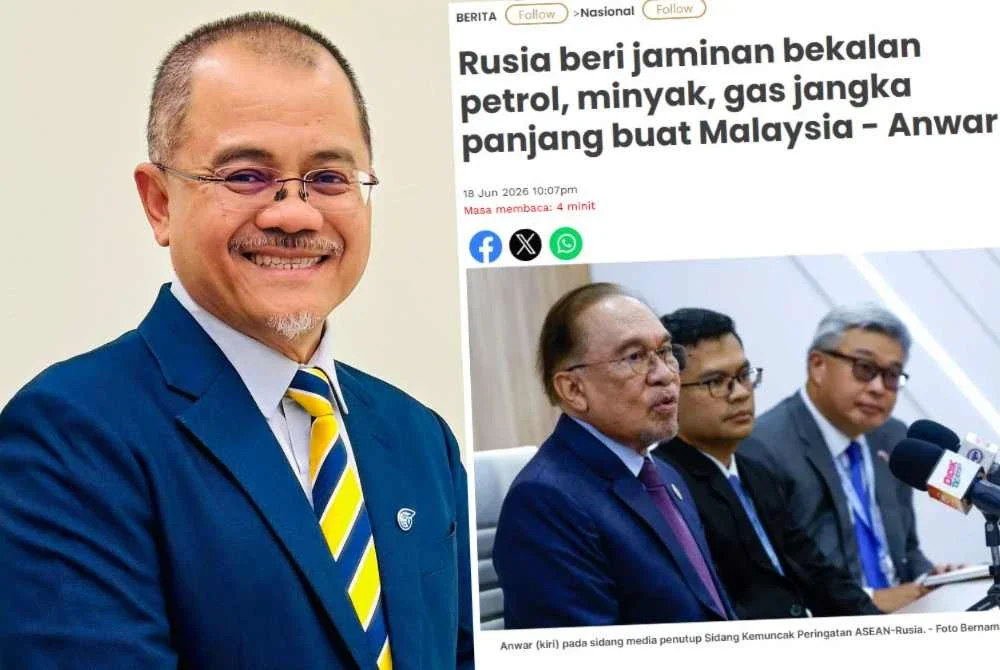
THE long-term oil and gas supply agreement with Russia has the potential to serve as an early bulwark against the risk of electricity tariff hikes, while also stabilising operational costs and household expenditures.
Economic analyst, Dr Aimi Zulhazmi Abdul Rashid said the utilities and power generation sector is expected to receive the greatest benefit should the agreement be successfully sealed, as fuel costs are a major component in energy generation.
According to him, a more stable energy supply could help mitigate tariff shocks to industries and consumers.
“If contract prices are more stable compared to global market prices, electricity bills, transportation costs and factory input costs will decrease or stabilise.
“This also has the potential to reduce the government’s fuel and electricity subsidy burden, thus providing more room for the country’s fiscal position.
“Fuel costs are the largest component, accounting for 60 to 70 percent of electricity generation costs. A more stable energy supply could help mitigate tariff shocks to industries and consumers,” he told Sinar Bisnes.
He was commenting on the impact of the long-term energy and oil supply cooperation guarantee extended by Russia to Malaysia as part of the multi-sectoral strategic relationship between the two countries.
The commitment was achieved through a bilateral meeting between Prime Minister Datuk Seri Anwar Ibrahim and Russian President Vladimir Putin in Kazan, Russia on Friday.
At the same time, he said through this cooperation, Malaysia gains significant benefits in enhancing international investor confidence and potentially opening up avenues for broader cooperation such as joint investments in the energy sector, the use of local currencies in trade transactions and technology transfer related to oil and gas.
This is because foreign investors are not only looking for countries that offer the cheapest energy, but they prioritise price stability and supply certainty over the long term.
“The benefit is in terms of cost certainty and investment planning. FDI investors, factories and data centres come to Malaysia not because gas is the cheapest in the world, but because costs can be projected for the next five years. That reduces Malaysia’s ‘risk premium’,” he said.
Geopolitical risks overshadow cooperation
However, he said the move to strengthen energy cooperation with Russia requires careful consideration given that international sanctions are still imposed on the country, particularly involving payment, insurance and logistics matters.
He explained that such a situation could impact financial institutions, shipping companies and parties involved in the supply chain should transactions not be managed carefully.
“Russia still faces sanctions from the United States (US), the European Union (EU) and the United Kingdom (UK). Banks in Malaysia, shipping insurance companies and freight forwarders could be affected if transactions involve payment systems in US dollars (USD) and SWIFT. Risks to note include the possibility of payment delays or higher insurance costs.
“At the same time, environment, social and governance (ESG)-based funds and Western investors are also sensitive to geopolitical issues. If Malaysia is perceived as being too close to Russia, there is a possibility that some foreign funds may withdraw their investments from Bursa Malaysia,” he said.
Aimi added that other risks that need to be assessed include the possibility of Malaysia being locked into long-term contracts that may become less competitive should global energy prices experience a significant decline in the future.
In addition, he said, supplies from Russia require longer and more complex shipping routes, thereby increasing the risk of delays and transportation costs.
“Contracts of 15 to 20 years can easily become expensive if global gas prices fall structurally due to increasingly cheaper renewable energy and hydrogen.
“Furthermore, overly strict ‘take-or-pay’ terms could result in the country still having to make payments even if the supply is not fully utilised.
“At the same time, shipping routes for supplies from Russia are longer and more complex as they require liquefied natural gas (LNG) carriers suitable for operations in icy areas, special insurance coverage and face the risk of extreme weather. This situation could increase the risk of delivery delays and contract-related penalties,” he said.
Recommendations for agreement terms
Therefore, he is of the view that the agreement would be worthwhile for Malaysia if the contract signed includes a balanced pricing mechanism such as minimum and maximum price caps and a hybrid formula, rather than relying entirely on oil price indices.
He said the contract should have flexibility in terms of supply volume, including a range of 80 to 120 percent according to current needs, as well as destination terms that are not too restrictive.
“In addition, payment and insurance arrangements must be resolved without exposing Malaysian financial institutions to the risk of international sanctions, including by leveraging platforms and economic cooperation among BRICS countries.
“However, Russia should not be the country’s sole source of energy supply. Malaysia still needs to maintain supply diversification through liquefied natural gas (LNG) imports from Qatar, Australia and the United States, alongside strengthening domestic gas supply and the development of renewable energy.
“Dependence on a single country should also not exceed approximately 30 to 40 percent of the country’s overall energy supply portfolio,” he said.
Sinar Harian