

US Concessions Fuel Tehran’s Nuclear Ambitions And Internal Oppression

Analysis – The inconsistency of US policy on Iran has enabled Tehran to boost its revenue and rapidly expand its nuclear program, while emboldening it to brutalize the Iranian people.
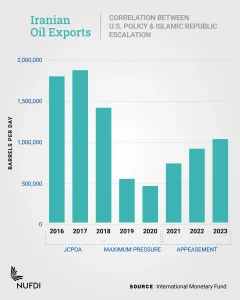
A look at the data on Iran’s oil exports, military revenue, nuclear advancements, and the number of executions in Iran show a trend. When the US posture towards Iran is softer, the regime sells more oil, has more money to spend on terrorism, expands its nuclear program, and brutalizes more Iranians.
Of course, correlation doesn’t necessarily equal causation. And there is no doubt that internal political factors within the regime in Iran, among other things, are a factor. So, let’s break down the data and some of the counter arguments.
Oil Exports
Of the data shown in the graph, Iranian oil exports is the most directly tied to US policy. From 2015 until the United States withdrew from the Joint Comprehensive Plan of Action (JCPOA), Iran, on average, exported roughly 1.6 million barrels per day (bpd). While the deal temporarily slowed Iran’s nuclear advancements, as will be discussed later, it did so at the cost of boosting the regime’s economy and oil sales through sanctions relief.
After the United States withdrew from the JCPOA and reinstated sanctions, oil exports sunk to a low of 440,000 bpd in 2020, with an average of 790,062 bpd during the “maximum pressure” years. US led sanctions were effective in limiting the number of countries able to purchase Iranian oil. However, when the new US administration took office in 2021 with the intention of re-entering the JCPOA, they abandoned the “maximum pressure” sanctions for a posture of appeasement, which in this instance refers to the United States relieving sanctions and diplomatic pressure on the Islamic Republic in the hopes that the regime would agree to a nuclear deal. The result is evident in Iran’s oil exports, which have risen back up to nearly 1.1 million bpd in 2024 and have averaged 925,562 bpd since 2015.
Though US sanctions may still be in place, that doesn’t mean they are being enforced. For example, the US reportedly agreed to a diplomatic arrangement with Iran in 2023 that included “stepping back from seizing Iranian oil cargoes.” According to the advocacy group, United Against a Nuclear Iran, the Islamic Republic had generated approximately $80 billion in revenue from oil sales between 2021-2023, hitting a five-year high in 2023. As noted in a recent Congressional Research Service (CRS) report, observers have speculated “competing global interests, a desire not to escalate tensions with China, or the pursuit of lower petroleum prices may have also informed the Biden Administration’s Iran sanctions policy in a way that de-prioritized the enforcement of sanctions.”
Military expenditure
Notable data points include a high of approximately $13.9 billion in 2017 in military expenditures, a low of roughly $3 billion in 2020, and a rise back to nearly $6.9 billion in 2022, likely to be higher in 2023, for which data is not out yet.
The explanation for the fluctuation in Iran’s military expenditure mirrors that of Iran’s oil exports. Relieving or not enforcing sanctions that target key industries which produce revenue for the Islamic Republic gives the regime more money to spend – and Tehran will always prioritize spending on its military over the Iranian people.
Recent US policy on Iran has operated under the belief that the United States can dictate how the regime spends its money. This has been the justification for many of the sanctions waivers the US has granted to allow money to flow from countries like Iraq into the regime’s pockets, as Biden administration officials claim the money can only be used for humanitarian purposes. The flaw in this logic, including the inherent fungibility of money, has been extensively written about.

Altogether
The juxtaposition of these various measurements shows that US policy on Iran influences both American national security and the welfare of the Iranian people. Therefore, both aspects should be integral to the formulation of any future US strategy regarding Iran. While applying ‘maximum pressure’ on the regime has yielded positive outcomes, providing ‘maximum support‘ to the Iranian people is an essential complementary measure.
This is not about politicians nor personalities, but rather policy – you may note that the time periods in the graph are divided based on US policy on Iran, not US presidents. The United States needs a bipartisan policy on Iran, one that has a clear long-term goal and doesn’t dramatically shift every few years. Such a policy should not only aim to curtail Iran’s nuclear ambitions and support for terrorism but also seek to uphold human rights and democratic values.
The data presented suggests that a US policy characterized by consistency, clarity, and firmness is more likely to restrain Iran’s adversarial actions than one marked by conciliation and appeasement. As we move forward, it is crucial for policymakers to internalize the lessons learned from past engagements with Iran, crafting a coherent strategy that addresses the multifaceted nature of the challenge at hand.