

Stop putting Syria’s Hayat Tahrir al-Sham on terror lists
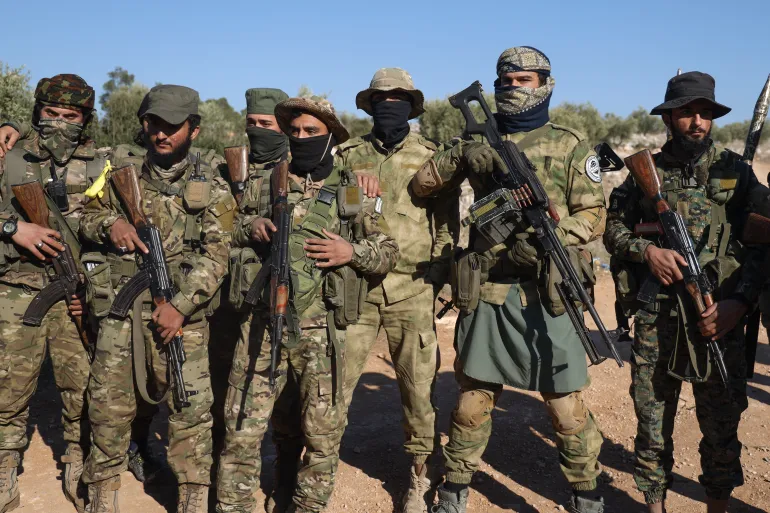
Are we facing the brightest future in Syria, or are we faced with ruthless terrorists? Last week, the insurgent group Hayat Tahrir al-Sham (HTS) led the offensive that culminated in the downfall of Syrian dictator Bashar Assad. Syrians are divided on this matter.
“They are also sons of the country,” stated Ghaith Mahmoud, 36, who has resided in Germany since 2016 but has engaged in combat against the Syrian government forces. “I am uncertain as to whether they are capable of managing the nation.” However, I am aware that all of the young men who fought as members of these organizations now desire to return home.
Other expatriates are less empathetic.They do not believe that HTS, which is currently responsible for the establishment of a new, transitional administration in the country, is trustworthy.
HTS committed to to refrain from imposing its Islamist policies on the nation, which is religiously and ethnically diverse. However, certain Syrians expressed concern over images of the interim prime minister, Mohammed al-Bashir, appointed by the High Tribunal for Syria (HTS). He sat at a desk with two flags behind him. The green and black flag of the Syrian revolution adorned one, while an Islamic supplication adorned the other.
Extremist groups and the Taliban in Afghanistan both prominently display the invocation on the Saudi Arabian flag.
Questions regarding the classification of the insurgent group as a terrorist organization are also raised by the policies that a new Syrian transitional government, which is imposed with HTS support, would implement.
HTS was previously associated with extremist organizations such as al-Qaeda and the “Islamic State” (IS).This is the reason why the United States designates HTS as a “foreign terrorist organization” and the United Kingdom considers it a “proscribed terrorist organization.”
The European Union maintains two registries that sanction terror groups. A spokesperson for foreign affairs informed DW that one is independent of the EU, while the other operates in accordance with the United Nations’ model. The EU’s own list does not classify HTS as a terror organization. However, due to its association with al-Qaeda and IS since 2013, the EU’s second, UN-based list continues to classify HTS as a sanctioned organization.
The spokesperson also stated that the EU would follow suit if the UN were to eliminate HTS from the list.
The HTS terror designation is the subject of a debate.
Geir Pedersen, the UN Special Envoy for Syria, indicated earlier this week that the terror designation of HTS required review in light of recent events.
At a press conference in Geneva, Pederson stated, “You must examine the facts and consider the events of the past nine years.” “Since the adoption of the resolution to include HTS on the terror list nine years ago, the Syrian people have received positive messages from HTS and other armed groups, promoting unity and inclusivity.”
Politicians from the United States and the United Kingdom have also suggested a reevaluation, even though most of the discussions have taken place in private.
Whether it will occur is uncertain, according to Aaron Zelin, a senior fellow at the Washington Institute and an expert on HTS.
“It’s understandable that governments would be discussing it just because of the change in [Syria’s] situation,” he indicated to DW. However, it is not necessarily because people do not see themselves as extremists.” In 2020, HTS requested that the United States remove them from the [terror] list.
Zelin proposed that Syria’s current geopolitical significance to the West could be advantageous to HTS, despite the fact that delisting did not occur at that time.
Right-wing and anti-immigration legislators in Europe are currently discussing potential ways to return Syrian refugees. However, international law is likely to forbid direct transportation of individuals to a nation under the control of a recognized terrorist organization, and it also prohibits nations from engaging in open and legitimate communication with such organizations.
However, HTS has already established interactions with at least a few governments that classify it as a terror organization. Turkey communicates with them, and the German Foreign Ministry indicates that it has methods of contacting HTS, as does its US counterpart.
In Washington on Tuesday, a spokesperson for the State Department stated, “We have the capacity to communicate with all pertinent groups within Syria.”However, he clarified that this does not mean that the United States has the legal right to give material support to a designated foreign terrorist organization.
The latter is an additional reason why it is worthwhile to take HTS’ terror designation into account, according to specialists.
It impedes access to humanitarian aid, which occurred following the catastrophic earthquake that struck Turkey and northern Syria in February 2023.
Organizations engaged in development and reconstruction in Syria face significant challenges due to the HTS terror listing and pre-existing sanctions on Syria’s Assad regime. HTS has declared its intention to establish a free-market economy; however, sanctions could have an international “chilling effect” on businesses and institutions, which may be overly cautious when conducting business with Syria.
Observers also suggest that the HTS terror listing warrants caution.
HTS originated from various extremist organizations in Syria; however, it severed these connections in 2016 and has since imprisoned, exiled, and engaged in combat with members of the Islamic State (IS) and al-Qaeda. Additionally, HTS has previously declared that it will not permit the use of its territory as a base for extremist attacks.
In mid-2023, the Center for Strategic and International Studies, a Washington-based organization, issued a brief that stated, “HTS poses a low threat to those outside of its immediate area of control.” “However, HTS’ authoritarian style of governance poses a threat to the local population.”
Like all other opposition militia groups in the country, HTS has governed an area in northern Syria with a population of over 3 million since approximately 2017.
Joseph Daher, a professor at the European University Institute and an expert on Syria, revealed in an interview with Tempest magazine this week that the group frequently enforces its policies through the murder of civil society activists, assassination of its rivals, and intimidation. “Many Syrians in areas under the group’s control express relief at the relative stability there but resentment at the group’s iron-fisted practices.”
The Crisis Group think tank’s specialists stated in a statement released on Thursday that HTS must now demonstrate its legitimacy in order to remove itself from the terror listing and achieve formal international recognition.
“Washington and other Western capitals should … lay out for [HTS military leader Abu Mohammed] al-Golani what he needs to do to get the terrorism designation lifted,” according to them. “[Al-Golani] must demonstrate to Syrians, particularly those who do not subscribe to his Islamist beliefs and the country’s minorities, as well as mistrustful neighbors and Western capitals, that his movement is capable of collaborating with others to guide the country toward a more promising future.” In response, the world should provide him with the opportunity to do so.
In the event that the international community deems the Syrian government’s actions insufficient, the Crisis Group proposed that officials could promptly reinstate the designation if they deem it warranted.