

Qatar’s Diplomatic Role Intensifies Amid US–Iran Tension and Regional Instability
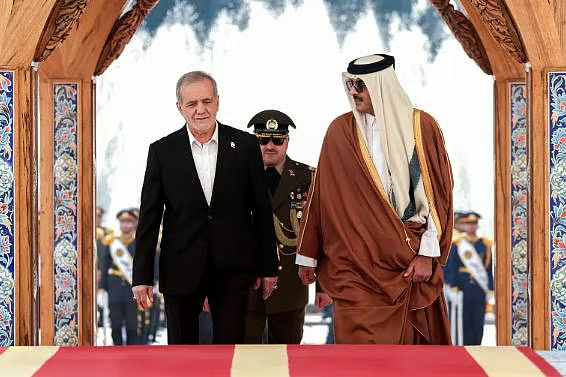
DOHA : As tensions between the United States and Iran continue to escalate, Qatar has quietly positioned itself as a critical diplomatic mediator working to prevent the crisis from spiraling into wider regional instability.
US–Iran confrontations have rarely remained confined to bilateral disputes. Recent unrest inside Iran, reports of civilian deaths, and increasingly harsh rhetoric from Washington and Tehran have once again heightened risks across the Gulf. US President Donald Trump’s public statements expressing support for protesters further sharpened tensions, raising fears of external intervention.
Given the Gulf region’s strategic geography, dense energy infrastructure, and interconnected security architecture, even limited conflict carries the potential to rapidly escalate. Against this backdrop, Qatar has consistently prioritized de-escalation, mediation, and the preservation of communication channels, particularly when direct dialogue becomes politically impossible.
During periods of intense crisis, Doha has established itself as a trusted and effective intermediary. Maintaining continuous ties with Tehran while hosting a strategic partnership with Washington, Qatar has facilitated discreet and reliable backchannels that allow both sides to manage tensions without public confrontation. These efforts have often enabled face-saving compromises and reduced the risk of miscalculation.
One of the clearest examples of this role came in September 2023, when Qatar brokered a US–Iran prisoner exchange alongside the release of frozen Iranian funds for humanitarian use. The agreement followed months of indirect negotiations and delicate coordination. While it did not signal broader rapprochement, it demonstrated that diplomacy remains possible even amid deep hostility.
For Qatar, mediation is not an end in itself but part of a broader strategic assessment. Doha has long argued that the Iranian nuclear issue and wider US–Iran tensions cannot be sustainably resolved through military pressure alone. Dialogue, not force, is viewed as the only viable path to long-term risk management and conflict prevention.
This approach does not reflect indifference to Iran’s regional conduct. Rather, it stems from a pragmatic calculation of costs, uncertainties, and unintended consequences. That calculus became evident in June 2025, when Iranian missile strikes targeted the US Al Udeid Air Base in Qatar following American attacks on Iranian nuclear facilities. Doha immediately activated emergency diplomatic channels with both sides, helping to stabilize a fragile but effective ceasefire.
Regional leaders remain acutely aware that any military campaign aimed at toppling Iran’s governing system would carry consequences far beyond its borders. The collapse of state authority could trigger internal fragmentation, ethnic and sectarian conflict, refugee flows, maritime insecurity in the Gulf, and severe disruptions to global energy markets—all posing immediate risks to neighboring states.
Recent developments have already altered the regional balance. Following the October 7 attacks, Iran-aligned armed groups have come under growing military and political pressure, reducing Tehran’s influence in some arenas. Meanwhile, US strikes in June 2025 underscored Washington’s readiness to directly target Iranian capabilities.
Yet from a Gulf perspective, the benefits of further escalation appear increasingly limited. Weakening Iran does not automatically translate into regional stability especially if it risks state collapse. The overriding objective among Gulf states is to avoid chaos that would be costly, unpredictable, and uncontrollable.
This assessment is not unique to Qatar. In recent years, Saudi Arabia and Oman have also pursued dialogue and confidence-building measures with Tehran, reflecting a broader regional preference for de-escalation over confrontation.
In an increasingly polarized Middle East, the value of quiet diplomacy is often underestimated. It lacks the visibility of military force or the simplicity of deterrence. Yet Qatar’s role between Washington and Tehran illustrates that even limited, slow, and imperfect diplomacy remains one of the few tools capable of preventing a larger war, one whose costs would extend far beyond the battlefield.