

Status Quo of Masjid Al-Aqsa Increasingly Threatened, Says Waqf Official
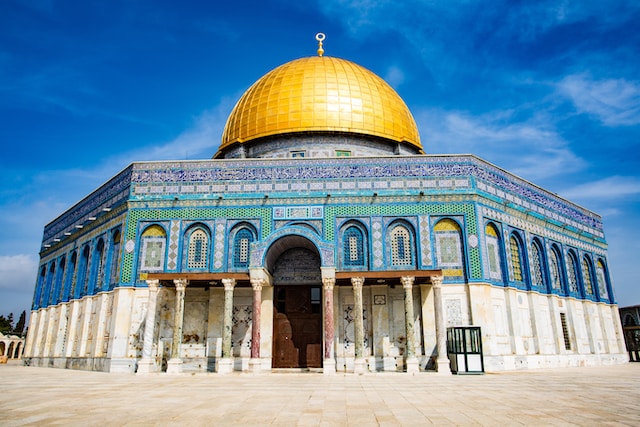
KUALA LUMPUR: The historical status quo at Masjid Al-Aqsa has been deteriorating in recent years, following increasingly stringent restrictions on Muslims and growing challenges to the long-standing arrangements governing the holy site.
Deputy Chairman of the Islamic Waqf Council in Jerusalem, Dr Mustafa Abu Sway said Israeli security forces are seen preventing people on a daily basis, including young people, women and sometimes the elderly, thus depriving them of their right to be at the mosque.
“So there is no freedom of movement, no freedom of worship, in reality, at Masjid Al-Aqsa,” he said during a live video interview from Masjid Al-Aqsa and the Dome of the Rock via the Bernama World programme produced by Bernama TV, recently.
He said this when discussing the topic “Palestine Beyond The Headlines: Protecting The Sanctity And Future Of Al-Aqsa Mosque.”
Abu Sway was appointed as the first Integral Chair for the Study of Imam Ghazali’s Works at Masjid Al-Aqsa and Al-Quds University in 2012.
In addition to the Islamic Waqf Council in Jerusalem, he is also a member of the Bani Hashim Fund for the Conservation of Masjid Al-Aqsa and the Dome of the Rock.
He said the historical status quo, established through an Ottoman decree in the 19th century, allows Muslims to worship at Al-Aqsa, while followers of other religions may visit under the administration of the Islamic Waqf, which is part of the Jordanian Ministry of Waqf.
He said the arrangement has been increasingly challenged since 2000, when the then Israeli opposition leader, Ariel Sharon, made a provocative visit to Al-Aqsa accompanied by security forces. Abu Sway said the visit triggered the second intifada (uprising) by the Palestinian people.
“Gradually, in recent years, under the leadership of Ben-Gvir, the Israeli National Security Minister, he has changed the situation by allowing settlers to worship.
In fact, certain parts of the mosque are not allowed to be entered by Muslims during their incursions,” he said.
Abu Sway said these developments pose “great challenges and risks” to the historical status quo of the mosque.
“These political leaders, whenever they want to increase support at the ballot box, they either do or say something irresponsible regarding Masjid Al-Aqsa, and this is the cause of the increase in extremist elements breaking into Masjid Al-Aqsa.
“There is no recognition of Masjid Al-Aqsa in their narrative. So, when they file petitions to the Israeli High Court, there is no mention of Masjid Al-Aqsa at all. They only speak about the ‘Temple Mount’. So, this is a very serious issue and could trigger a conflict that extends beyond this region,” he said.
Abu Sway said Al-Aqsa is part of the faith and identity of Muslims worldwide, including in Southeast Asia. It is closely linked to the Isra’ event of Prophet Muhammad SAW from Makkah to Jerusalem. In Jerusalem, he led other prophets in prayer at the mosque.
“The entire Al-Aqsa Compound is part of Masjid Al-Aqsa and not a single specific building. Muslim countries and states have a role and responsibility to support Jordan in relevant international forums, and we think Malaysia is an important country that can play a significant role in the preservation of Al-Aqsa,” he said.
Regarding Jordan’s role as the custodian of Muslim and Christian holy sites in Jerusalem, Abu Sway said what is needed is widespread international recognition of Jordan’s role.
“What is needed is for the entire Arab and Muslim world, even the international community, to recognise the custodianship of the holy sites carried out by Jordan, and we would like to see a more active role played by Arab and Muslim countries as well as friendly nations for peace and stability,” he said.
He also called on foreign ministers and key leaders to speak up regarding Masjid Al-Aqsa, to stop these incursions and coordinate with Jordan on the next steps.
Regarding the overall situation, Abu Sway said efforts to end the occupation and return to a two-state solution require a serious major action plan, while stressing that no peace can be achieved without recognition of the religious, historical and political rights of the Palestinian people.
BERNAMA