

Malaysia Unveils RM611 Billion 13MP to Reshape National Development Towards AI-Driven Future
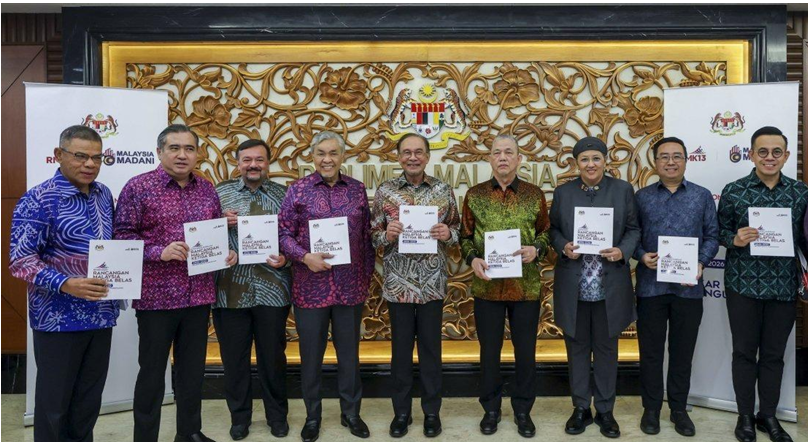
KUALA LUMPUR: Prime Minister Datuk Seri Anwar Ibrahim today tabled the 13th Malaysia Plan (13MP) in the Dewan Rakyat, unveiling a comprehensive development blueprint that outlines RM611 billion in total investments to transform the nation’s economic, social, and governance landscape over the period 2026 to 2030.
With the theme “Reshaping Development,” the five-year plan is strategically anchored on four key pillars:
-
Economic diversification,
-
Enhanced social mobility,
-
Acceleration of public service reform, and
-
Improved well-being and environmental sustainability.
Delivering a 90-minute address, Anwar emphasized that the plan is a critical continuation of the MADANI Government’s policy direction, which prioritizes inclusivity, sustainability, and institutional integrity.
“Since assuming office in November 2022, the MADANI Government has taken bold and decisive steps to reset the nation’s policy trajectory. This is encapsulated in the MADANI Economy framework, built upon sustainability, public well-being, and sound governance,” Anwar said.
The 13MP is structured around three guiding principles:
-
Building a sovereign and dignified nation-state,
-
Establishing a human-centric MADANI social system, and
-
Transitioning to an AI-powered digital economy.
RM611 Billion Investment Plan: A Multi-Sectoral Approach
To execute the development roadmap, the government estimates RM611 billion in total investments over the five-year period:
-
RM430 billion will be allocated directly by the federal government.
-
RM120 billion sourced from Government-Linked Companies (GLCs) and Government-Linked Investment Companies (GLICs),
-
RM61 billion through Public-Private Partnership (PPP) initiatives.
Of the RM430 billion federal allocation:
-
RM227 billion is earmarked for the economic sector.
-
RM133 billion for social development,
-
RM51 billion for security,
-
RM40 billion for education,
-
RM17 billion for administrative improvements.
Anwar noted that these allocations aim to unlock high-value economic activities while strengthening social safety nets and institutional capacity.
Digital Government and AI Economy
A significant focus of 13MP is on embracing digitalization and Artificial Intelligence (AI). Key initiatives include:
-
MyDigital ID, a secure digital identification system to enhance access to government services,
-
A target of 95% of federal public services being fully digitalised by 2030,
-
Expansion of 5G coverage to 98% of populated and industrial areas, including rural regions,
-
Development of 5,000 digital entrepreneurs and strategic investments in data center infrastructure.
The digitalization push is expected to generate 700,000 new jobs in manufacturing and 500,000 careers in the digital economy, positioning Malaysia as a regional technology leader.
Cost of Living & Social Assistance
To ease living costs, the government will continue and expand support schemes, including
-
STR (Sumbangan Tunai Rahmah),
-
SARA (Savings Initiative),
-
Payung Rahmah, encompassing affordable food programs such as Jualan Rahmah, Menu Rahmah, and Kafe Rahmah.
Education, Housing, and TVET Expansion
The government will allocate RM67 billion to education, including:
-
Construction of new schools,
-
Upgrades to existing facilities, including KEMAS kindergartens and higher education institutions.
The 13MP also strengthens Technical and Vocational Education and Training (TVET) through:
-
MADANI TVET Financing Scheme,
-
Expansion of TVET opportunities to tahfiz students, aiming to produce a new generation of technocrat huffaz.
In housing, the plan targets the construction of one million affordable housing units between 2026 and 2035 through joint federal, state, and private initiatives.
Infrastructure and Regional Development
Transport infrastructure will see major upgrades, including:
-
Acquisition of 1,200 new buses, 300 DRT vans, and 217 train sets,
-
Completion of major highways such as the Central Spine Road, Pan Borneo Highway, and Trans-Borneo Highway,
-
Upgrade of 2,800 km of rural roads.
The plan also prioritizes positioning Sabah and Sarawak as regional clean energy hubs, with initiatives like the Sarawak Hydrogen Hub and the Sabah Energy Security Programme.
The East Coast states (Kelantan, Pahang, and Terengganu) will be transformed into national food production centers and benefit from large-scale agriculture initiatives to reduce reliance on food imports and boost the agri-food sector’s value to RM58 billion by 2030.
Health, Labour, and Indigenous Rights
To reduce out-of-pocket health expenses, RM40 billion will be allocated for healthcare improvements, while labor policies will support automation and local hiring to reduce dependency on foreign labor.
In a landmark move, the Orang Asli Act 1954 will be reviewed to enhance land rights, education, and infrastructure access for Malaysia’s indigenous communities.
A National Call to Action
Prime Minister Anwar concluded by urging collective ownership and participation in the implementation of 13MP.
“This plan must be owned by all — every individual, community, private sector entity, and government institution. With unity, commitment, and a shared vision, Malaysia will rise as a respected global nation powered by its values, principles, and resilience,” he said.
The 13MP sets an ambitious course for Malaysia to become a high-income, technology-driven nation while preserving its social fabric and environmental sustainability.