

Jaishankar Calls for Dialogue and Stability as BRICS Meeting Opens Amid Iran–UAE Tensions
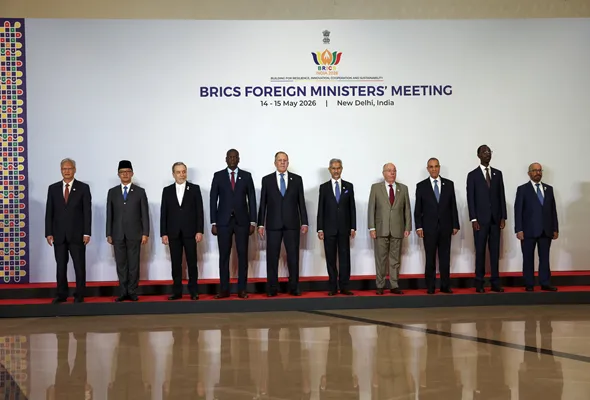
NEW DELHI : Peace and diplomacy remain central to the global order, India’s Foreign Minister Subrahmanyam Jaishankar said on Thursday, as BRICS foreign ministers gathered for a two-day meeting overshadowed by tensions between Iran and the United Arab Emirates.
“Peace and security remain central to the global order. Recent conflicts only underline the importance of dialogue and diplomacy,” Subrahmanyam Jaishankar said in his opening remarks in New Delhi.
The meeting comes as the expanded BRICS grouping faces internal differences, particularly between Iran and the UAE, which are on opposing sides of the ongoing US-Israeli war involving Iran. These divisions have complicated efforts to reach consensus on a joint closing statement.
Foreign ministers from most member countries attended the gathering, including Iran’s Foreign Minister Abbas Araqchi and the UAE’s Deputy Foreign Minister Khalifa Shaheen Al Marar.
The BRICS bloc, originally formed by Brazil, Russia, India and China, expanded in 2011 with South Africa joining. More recently, Egypt, Ethiopia, Indonesia, Iran and the UAE were added. India currently holds the BRICS chair for 2026.
Jaishankar noted that rising geopolitical tensions have increased expectations for BRICS to act as a stabilising force for developing and emerging economies.
“There is a growing expectation, particularly from emerging markets and developing countries, that BRICS will play a constructive and stabilising role,” he said.
However, the inclusion of countries with opposing geopolitical positions has made unified positions more difficult, especially on conflicts involving Iran, where diplomatic divisions are now more visible within the bloc.
The outcome of the meeting is expected to reflect these challenges as members attempt to balance differing national interests while maintaining cooperation on global economic and political issues.