

Industry-aligned STEM talent development is the focus of partnership pledged by the Higher Education Ministry
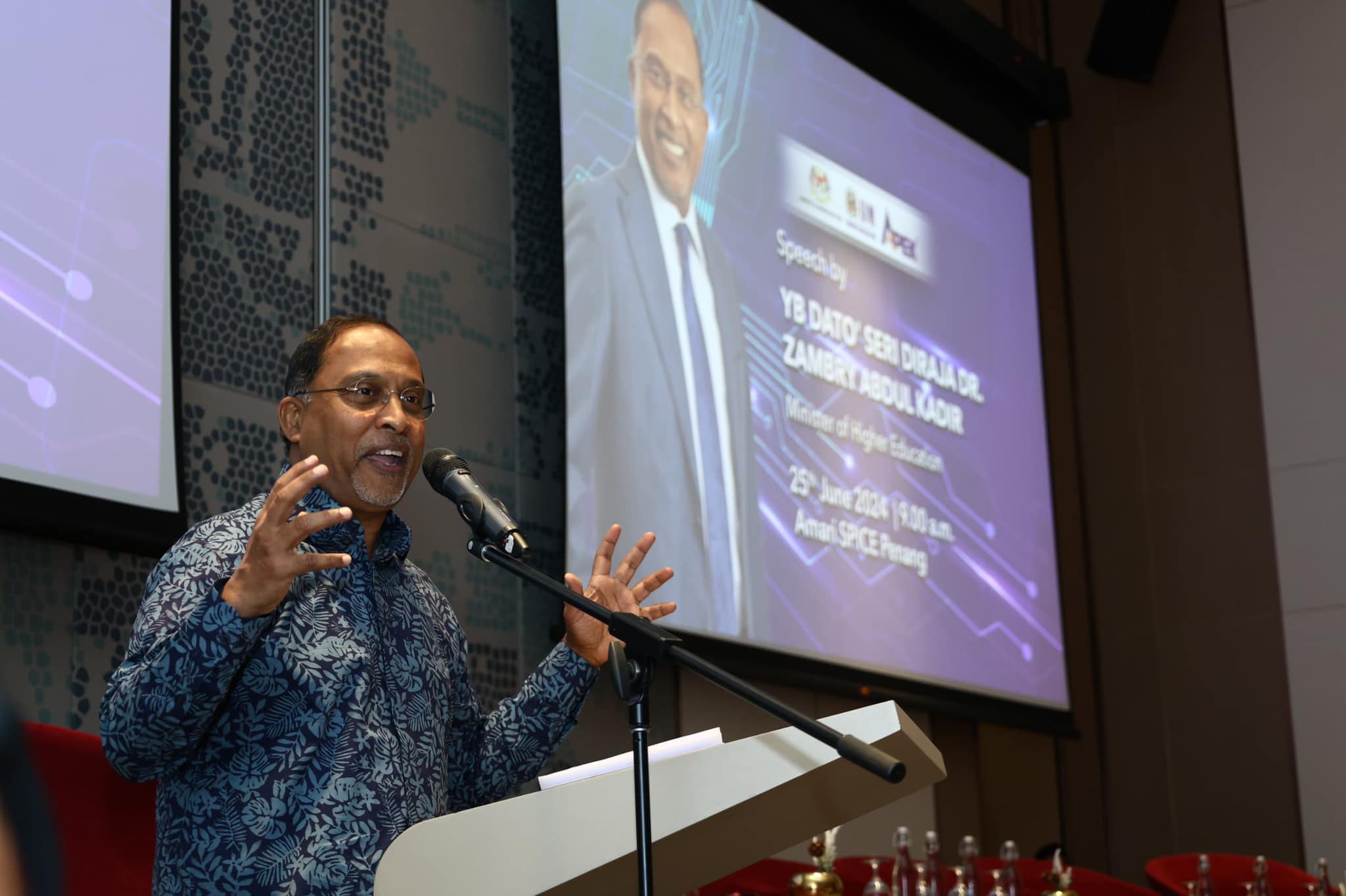
GEORGE TOWN: Minister Datuk Seri Zambry Abdul Kadir told reporters that the Higher Education Ministry is willing to work with other ministries as well as the electrical and electronics (E&E) sectors to develop talent that would satisfy market expectations.
He underlined the ministry’s approach of keeping doors open for dialogue with other ministries and industries in order to address the demands of certain industries.
During a speech at an E&E Industry dialogue session today at Amari Spice Penang, he stated, “We are examining policies to determine what we can offer to meet industry needs.”
Particularly with semiconductor foreign direct investors (FDI) arriving to Malaysia, Zambry emphasised the growing need for highly skilled labour.
“We need to take a more adaptable stance and get away from a higher education system that is centred only on campuses or universities in Malaysia in order to solve this,” he stated.
Working with nearby institutions is one strategy that businesses can use.
“Our goal is for local universities to receive a portion of industry research funds so that we can work together to develop industry-ready talent,” he said.
Increasing the number of Technical and Vocational Education and Training (TVET) programmes in the semiconductor industry is another tactic.
He said, “I suggest that we start 100 of these TVET programmes so that we can produce 200,000 engineers by 2030.”
Zambry brought attention to a disparity between pupils studying science and liberal arts.
“Roughly 40 percent of students start out in the science stream, but five to 10 percent eventually transfer to the arts,” he stated.
He suggested offering liberal arts and humanities students the chance to transfer into Science, Technology, Engineering, and Mathematics (STEM) degrees as a solution to this problem.
He said, “Students in the humanities and liberal arts who do well in math and science can enrol in STEM programmes through the TVET foundation programme.”
Zambry mentioned that last year, polytechnics started providing liberal arts students with STEM foundation curricula.
He continued, “The first group of 463 students will graduate soon.”
While concentrating on TVET for the time being, he stressed the need for institutional changes to draw more kids to STEM in the secondary and primary levels.
He declared, “We aim to elevate TVET’s status, especially in critical engineering and technical fields. TVET is not just about low-level technical courses.”
Zambry concluded by saying that Malaysia might pick from tips on how to transition students from liberal arts to hard science from Germany and Japan.
He said, “We can also investigate work-based learning and worker upskilling.”