

As Middle East political risks subside, crude oil prices saw their biggest decline in more than two years
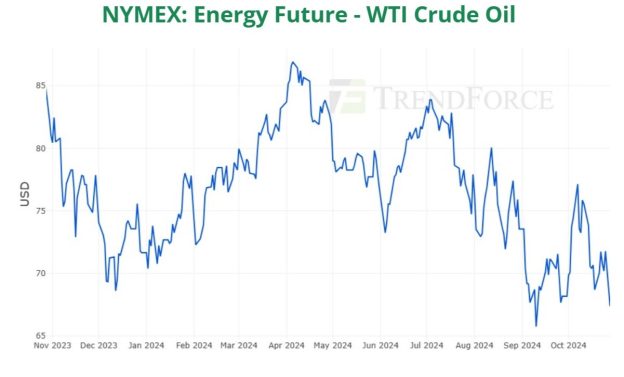
Israel’s recent strikes on Iran did not affect any oil extraction facilities, which reduced the political risk premium associated with the Middle East. As a result, crude oil prices have dropped precipitously, the biggest single-day loss in almost two years.
Israel responded to Iran’s over 200 missiles fired three weeks ago with attacks on Iranian military installations last Saturday. But at the request of U.S. President Joe Biden, Saturday’s strikes did not cause any damage to any oil extraction facilities that are members of OPEC+.
The U.S. Energy Information Administration (EIA) said in early October that the EIA’s 2025 daily oil supply growth prediction was revised downward to around 2 million barrels per day (formerly 2.4 million) due to the recent drop in oil prices. However, it is still anticipated that the world’s daily oil supply will reach 102.5 million and 104.5 million barrels in 2024 and 2025, respectively, with OPEC+ continuing production rises through late 2024 and non-OPEC countries continuing to raise output through 2025.
On the demand side, the EIA lowered its demand projections for both China and OECD nations due to a worldwide manufacturing slump and slower Chinese oil imports. According to current projections, the world’s daily oil consumption will reach 103.1 million barrels in 2024 and 104.3 million barrels in 2025.
Furthermore, the initial projections of 1.2 million and 900,000 barrels of net daily demand increase for Q1 2024 and Q2 2025 have been revised lower to roughly 600,000 and 500,000 barrels, respectively.
Overall, with the Middle Eastern political risk premium falling, crude oil prices are heading for a fundamentally poorer outlook in the medium to long term. On October 28, WTI crude futures dipped to $67.38 per barrel, while Brent crude slid to $71.42 per barrel.