

Anwar Ibrahim Opens 58th ASEAN Foreign Ministers’ Meeting with Call for Strategic Cohesion and Regional Leadership
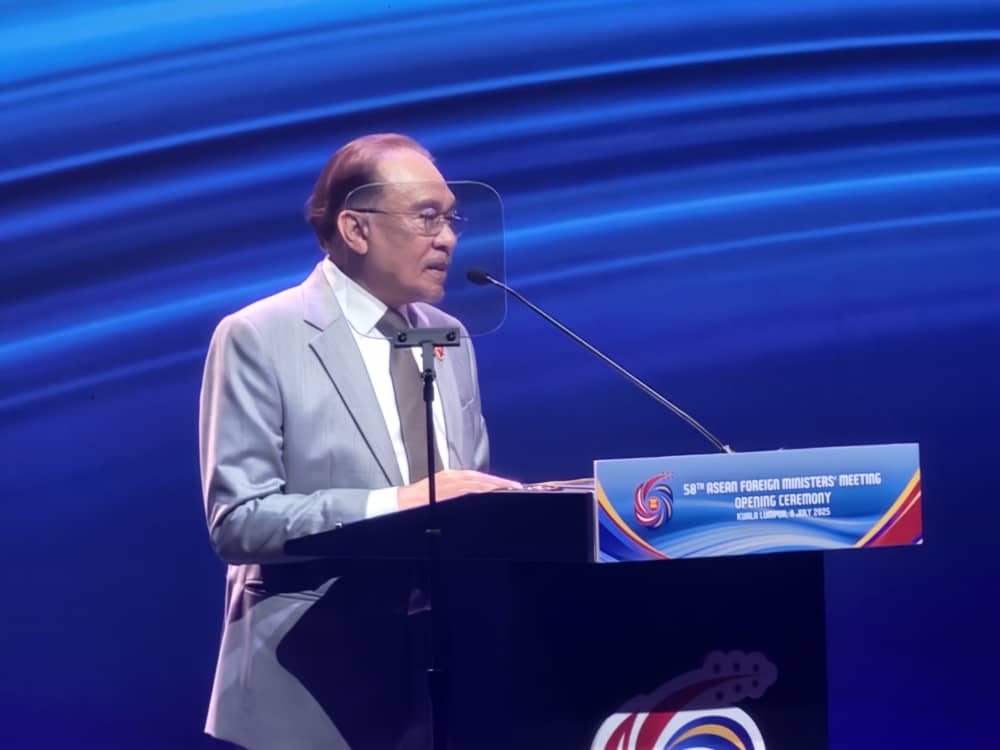
KUALA LUMPUR, 9 July 2025 (Voice of Malaysia)— Malaysian Prime Minister Dato’ Seri Anwar Ibrahim officially inaugurated the 58th ASEAN Foreign Ministers’ Meeting (AMM) in Kuala Lumpur today, delivering a keynote address that underscored the imperative for regional unity, strategic alignment, and strengthened institutional resilience amid escalating global tensions.
Addressing foreign ministers from ASEAN Member States and Timor-Leste, alongside ASEAN Secretary-General Dr. Kao Kim Hourn and other distinguished guests, Prime Minister Anwar framed the 2025 Chairmanship as a defining juncture for ASEAN’s trajectory toward Vision 2045.
“This Chairmanship has come at a moment when choices must be made: about ASEAN’s priorities, its voice in the world, and how we shape the region between now and 2045,” he said.
The prime minister reflected on ASEAN’s founding ethos, describing it as a coalition born not of ease, but of complexity—built by nations that recognized the dangers of fragmentation and the promise of continuous dialogue.
“Our region’s strength lies not in the absence of tension, but in our commitment to manage it through mutual respect, continuous engagement, and consensus,” Anwar affirmed.
He reiterated Malaysia’s longstanding support for Timor-Leste’s accession, anticipated in October 2025, and called on Member States to facilitate its seamless integration into both ASEAN institutions and the collective vision for the region’s future.
The Prime Minister’s remarks conveyed deep concern over the breakdown of global norms and the erosion of multilateral frameworks, citing enduring conflicts in Gaza, Ukraine, and Myanmar, and rising tensions across the Middle East. He warned that unilateral actions by certain states risk triggering broader regional instability, particularly in matters affecting energy security, global peace, and the international legal order.
“The multilateral system cannot endure if its principles are upheld only when convenient,” Anwar stated. “ASEAN must be among those who choose to stand for rules, even when others retreat.”
He emphasized that principles and pragmatism are not mutually exclusive and that ASEAN must harness both to navigate an increasingly contested global environment.
On economic challenges, Anwar pointed to the emerging trend of geoeconomics, where trade instruments once used for growth are now employed as tools of geopolitical pressure. Describing it as “the new weather of our time,” he called for an assertive and coordinated regional response.
“Our cohesion must not end at declarations. It must be embedded in our institutions, our strategic outlook, and our economic policies,” he urged.
The prime minister advocated for tighter policy integration between ASEAN’s foreign affairs and economic sectors, in line with ASEAN Vision 2045, to enhance collective resilience through increased intra-regional trade, investment, and sectoral connectivity.
Anwar reaffirmed the principle of ASEAN Centrality as the cornerstone of regional diplomacy, cautioning against renewed attempts to divide the region into external spheres of influence.
“We are a region that charts its own course — deliberately, coherently, and with purpose. ASEAN will not be spoken for in absentia,” he said, reiterating the importance of ASEAN-led platforms in shaping the Indo-Pacific order.
The prime minister closed with a compelling reminder that ASEAN’s legitimacy is grounded not in communiqués, but in tangible outcomes that directly benefit its citizens—from food security to education, digital transformation, and climate resilience.
“From Batambang to Chiang Rai, from Sittwe to Dili, our people are the purpose of this community,” he stated. “Let this meeting reaffirm our conviction: that ASEAN will remain coherent, resilient, and respected.”
With that, Anwar formally declared the 58th ASEAN Foreign Ministers’ Meeting open, setting the tone for a week of strategic dialogues, trilateral engagements, and high-level policymaking at a time of mounting global complexity.