

ASEAN Reforms Trade Strategy by Promoting Use of Local Currencies — PM Anwar
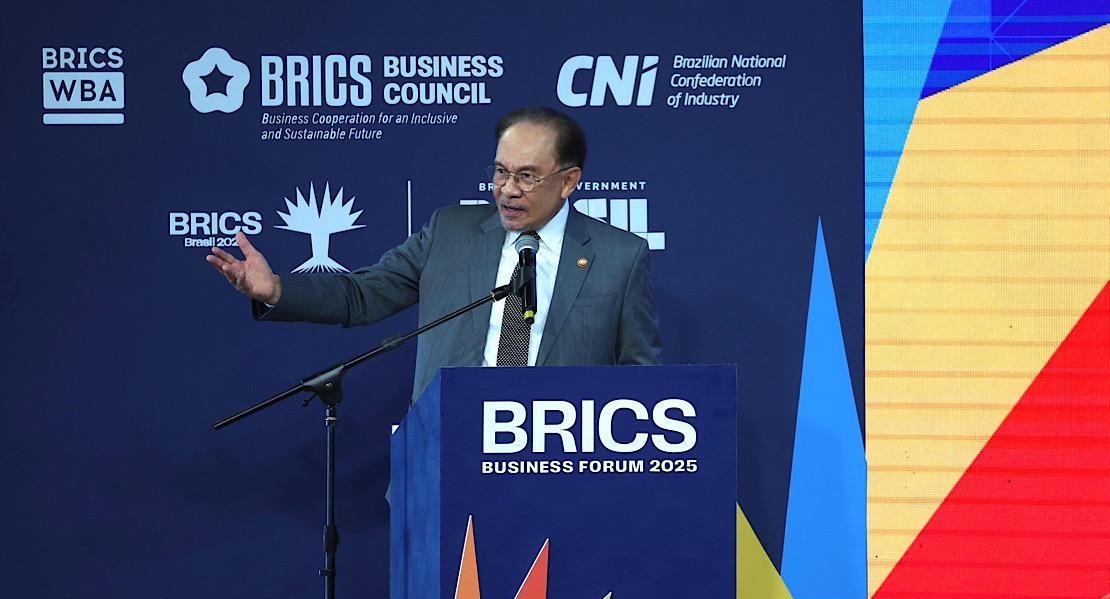
KUALA LUMPUR|| July 5: Prime Minister Datuk Seri Anwar Ibrahim has announced that ASEAN is actively reforming its trade mechanisms by encouraging the use of local currencies among member nations, aiming to build a more stable financial system less vulnerable to unilateral dominance.
Speaking at the BRICS Business Forum titled ‘Bridging Continents, Building Future: A Shared Agenda for Sustainable Progress’ in Rio de Janeiro, Brazil, Anwar said that this move, while still in its early stages, reflects a clear intent to reshape regional trade practices.
“We are not yet talking about full de-dollarization—that’s still a long way off. But we are making progress. Malaysia, along with Indonesia, Thailand, and China, has started using local currencies for trade, even if it’s just 10 or 20 percent of trade volume,” he said.
“It makes a difference. We cannot keep complaining without executing our plans—both among ourselves and with our friendly neighbors.”
The forum, attended by Brazilian President Luiz Inácio Lula da Silva, Vice President Geraldo Alckmin, and Brazilian Confederation of National Industry (CNI) president Ricardo Alban, served as a platform to foster collaboration among emerging economies across regions.
Anwar stressed the importance of ASEAN centrality, advocating for unity, multilateralism, and principled diplomacy in global affairs.
“Southeast Asian nations must go beyond rhetoric and empty statements. We need real, concrete action that reflects our shared commitment to justice, progress, and sustainable development.”
He noted that emerging economies are making remarkable strides in sectors like aviation, technology, artificial intelligence, and food innovation, and expressed optimism that initiatives like those spearheaded by BRICS could shift the global economic landscape.
“I believe that this effort by BRICS will achieve significant success—one that may alter the course of history,” Anwar remarked.
The prime minister called for stronger strategic cooperation between BRICS and ASEAN countries, particularly in enhancing cross-regional trade and investment, to benefit developing nations collectively.
“We must be cohesive and speak as one, building on multilateral arrangements that support shared prosperity and equity.”
Anwar’s comments highlight Malaysia’s proactive role in advancing economic resilience within ASEAN while also seeking broader alliances with global partners to reform the international financial architecture.