

Sri Tanjong 1 Ferry: JKR’s Legacy Strengthens Malaysia-Thailand Relations
IN northern Kelantan, Pengkalan Kubor is more than just a border town. Separated from Tak Bai in Narathiwat, Thailand, by the Golok River, the area has served as one of the important gateways connecting the two neighbouring countries for decades.
For thousands of residents who commute daily for work, business, family visits or official matters, the ferry service is an essential transport lifeline that has become an inseparable part of their lives.
Behind the smooth operation of this service, the Public Works Department (JKR), through its Road Facilities Maintenance Branch (CSFJ), plays a crucial role in ensuring that cross-border transport continues to operate safely, efficiently and reliably.
Today, that legacy continues with the operation of the Sri Tanjong 1 Ferry, a modern vessel that replaces the original Sri Tanjong Ferry after more than three decades of service.
Its introduction not only renews the country’s transport assets but also symbolises the government’s commitment to strengthening Malaysia-Thailand relations and supporting economic development in border areas.
The history of the Pengkalan Kubor ferry service began with a decision by the Malaysia-Thailand Joint Socio-Economic Development Committee (SEDEC) on December 11, 1982, when both governments agreed to provide ferries with identical specifications to facilitate cross-border movement.
Following the agreement, Malaysia built the Sri Tanjong Ferry in Penang, which began operations on April 1, 1990.
The ferry was subsequently officially launched on August 16, 1990, in conjunction with the opening of the Malaysia-Thailand Immigration, Ferry and Lighthouse Complex, while Thailand operated the Taba I ferry.
Since its first day of operation, the Sri Tanjong Ferry has served as a vital link between Pengkalan Kubor and Tak Bai, covering a crossing distance of approximately 400 metres.
Although the journey takes only a few minutes, its impact has been significant, facilitating trade, tourism, education and social interaction between communities in both countries.
The ferry service operates under a Memorandum of Understanding (MoU) between Malaysia and Thailand, which outlines various aspects, including operating hours, fare revenue management and cooperation mechanisms in the event of technical disruptions.
This arrangement ensures that services remain uninterrupted if one ferry experiences mechanical problems, as the neighbouring country’s ferry can continue operating while repairs are carried out by the respective asset owner.
For JKR, managing the ferry service goes beyond daily operations. It also involves asset maintenance, compliance with maritime safety standards, financial management, administration and human resources, all coordinated by an experienced team.
Ferry crew members hold Certificates of Competency recognised by the Marine Department Malaysia, ensuring that every crossing complies with international safety standards.
Safety Remains the Top Priority
After more than 30 years of operation, the Sri Tanjong Ferry continued to undergo regular maintenance to ensure optimal operational performance.
Among its major upgrades was the replacement of two main engines in 2013 to improve the ferry’s efficiency and reliability.
In addition, scheduled maintenance, including dry docking, was carried out to ensure the vessel continued to meet the requirements for renewing its Passenger Certificate as stipulated by the Marine Department Malaysia.
Although maintenance costs increased as the vessel aged, JKR remained committed to carrying out maintenance without compromise, placing passenger safety above all else.
This commitment enabled the ferry service to remain the preferred transport option for local communities for more than three decades.
Like other transport sectors, ferry operations were also significantly affected by the Covid-19 pandemic.
The closure of international borders during the Movement Control Order (MCO) period resulted in the complete suspension of ferry operations in 2021, following a sharp decline in revenue collection the previous year.
However, the reopening of borders brought renewed hope as economic activities began to recover.
Residents gradually returned to using the ferry service for their daily activities, while cross-border trade and tourism recovered in stages.
The experience became a catalyst for efforts to strengthen existing infrastructure and improve preparedness for future challenges.
Sri Tanjong 1 Ferry: A Symbol of Transformation
To ensure the continuity of the service, the government approved the construction of the Sri Tanjong 1 Ferry at a cost of nearly RM7.9 million.
The new ferry was built by Sumber Samudra Sdn Bhd in Sitiawan, Perak, beginning in March 2024.
It was handed over to JKR on February 28, 2025, before commencing operations on April 11 of the same year.
Featuring a more modern design and advanced technology, the Sri Tanjong 1 Ferry can accommodate 58 passengers and six crew members, as well as up to eight light vehicles or one bus per crossing.
The ferry is also equipped with more efficient and environmentally friendly engine and power generation systems, ensuring smoother, safer and more comfortable operations for passengers.
This investment represents more than the replacement of an ageing asset. It demonstrates the government’s determination to strengthen public facilities that directly benefit the people.
A New Landmark for Pengkalan Kubor
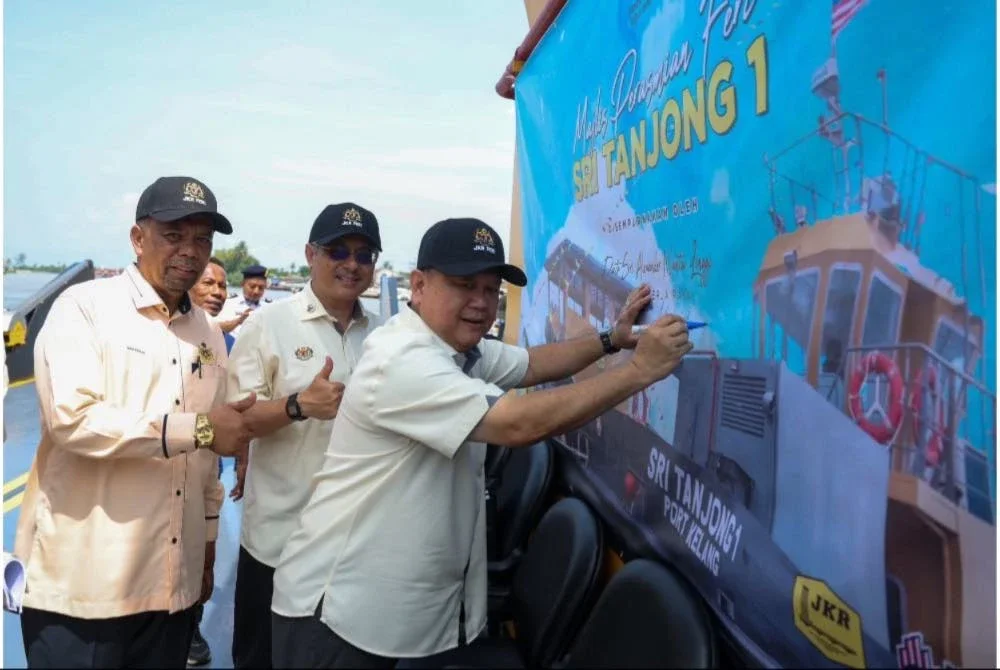
Works Minister Datuk Sri Alexander Nanta Linggi, together with Public Works Director-General Datuk Wira Ir Roslan Ismail, officiated the launching ceremony of the Sri Tanjong 1 Ferry at the Pengkalan Kubor Ferry Jetty in Kelantan on August 9, 2026.
The ceremony marked another important milestone in the history of the country’s ferry services, with the new vessel officially becoming a key transport link between Malaysia and Thailand.
More than just a ferry, Sri Tanjong 1 reflects JKR’s capability to deliver infrastructure that meets current needs while supporting the national development agenda.
With more modern technology, improved capacity and enhanced safety features, the ferry is expected to continue serving as a catalyst for economic growth, trade and cross-border tourism.
At the same time, it further strengthens the longstanding close relationship between Malaysia and Thailand.
JKR’s commitment to ensuring efficient, safe and high-quality service delivery demonstrates that infrastructure development is not merely about constructing physical assets.
Instead, it represents a long-term investment that benefits the people, strengthens national competitiveness and promotes the well-being of border communities for generations to come.
Sinar Harian