

Malaysia Eyes Sustainable Growth in Rare Earth and Thorium Development — Chang
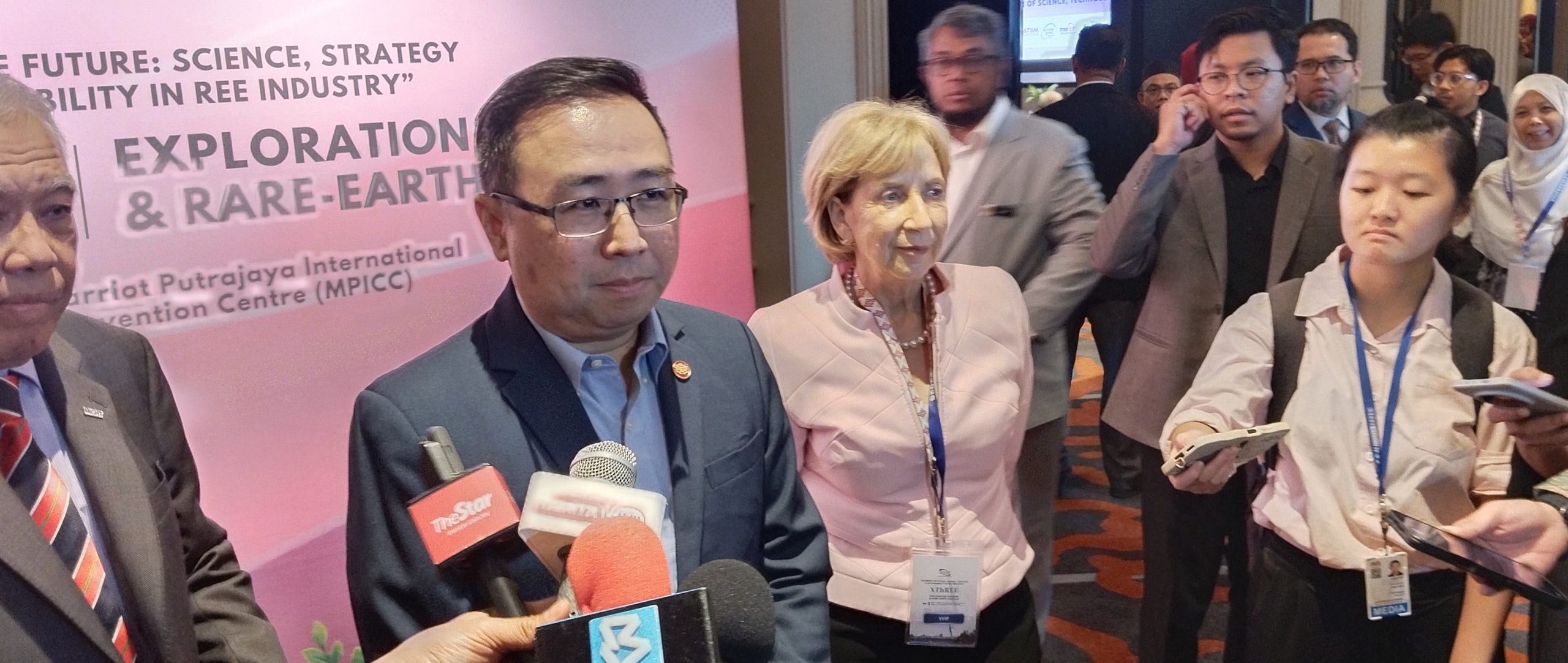
PUTRAJAYA, Nov 3 — Malaysia must build its future in rare earth elements (REE) and thorium development on the pillars of science, strategy, and sustainability, said Science, Technology and Innovation Minister Chang Lih Kang.
Delivering his opening address at the Seminar on Exploration, Thorium and Rare Earth (XThREE) 2025 at the Marriott Putrajaya International Convention Centre today, Chang said the growing global demand for REE presents both a challenge and an opportunity for Malaysia to become a responsible regional player in the critical-materials ecosystem.
“The presence of participants from government, industry, academia, and the research community reflects our shared recognition of the importance of thorium and REE development — a field that will shape our sustainable growth and technological future,” he said.
Organised by the Malaysian Association of Research Scientists (MARS) and the Thorium Project Management Office (ThX), the seminar carries the theme “Securing the Future: Science, Strategy & Sustainability in REE and Thorium.”
Chang noted that the global REE market, valued between USD 3.9 billion and USD 13 billion in 2024, is projected to more than double by 2030, driven by demand for electric vehicles, wind turbines, and advanced electronics.
He pointed out that China currently dominates about 70 percent of global REE processing capacity, creating vulnerabilities in global supply chains.
“For Malaysia, this presents both a challenge and an opportunity — to move beyond being a resource holder and to become a trusted and sustainable regional partner in the critical-materials ecosystem,” he added.
Malaysia’s Resource Potential and Institutional Strength
Chang highlighted that Malaysia possesses significant REE and thorium resources, particularly within ion-adsorption clay deposits that are low in radioactivity and manageable environmentally.
Preliminary studies have identified an inferred REE resource of 16.1 million metric tonnes, with an estimated in-situ value exceeding RM809 billion, across Perak, Kedah, Terengganu, and Sarawak.
“Our true advantage lies not only beneath the ground but also in our scientific capacity and strong institutional governance,” he said, citing agencies such as Nuklear Malaysia, Department of Minerals and Geoscience (JMG), and Department of Atomic Energy (Atom Malaysia) as examples of Malaysia’s technical readiness.
He also underscored Malaysia’s robust regulatory framework, noting that the Atomic Energy Licensing Act [Act 304] aligns fully with standards set by the International Atomic Energy Agency (IAEA).
To ensure coordinated policy implementation, the government has formed a Special Task Force on Rare Earth Elements, bringing together MOSTI, the Ministry of Natural Resources and Environmental Sustainability (NRES), Ministry of Investment, Trade and Industry (MITI), Ministry of Finance (MOF), and state governments.
“This whole-of-government approach ensures that every stage — from exploration to processing and downstream applications — is developed with transparency, responsibility and shared benefit for the people and the nation,” he said.
MOSTI’s Role: Science-Driven Governance
Chang said MOSTI plays a central role as the “science and technology engine” driving Malaysia’s emerging REE and thorium sector.
Through the National Advanced Materials Technology Roadmap (NAMTR), MOSTI is working closely with universities, research institutions, and industry players to localise technologies, promote value-added processing, and strengthen research-to-industry linkages.
Aligned with the 13th Malaysia Plan (RMKe-13) and the New Industrial Master Plan (NIMP 2030), the roadmap connects local innovation to global value chains in advanced materials and clean technologies.
He added that targeted initiatives — including the Strategic Research Fund (SRF), National Advanced Materials Council (NAMC), and Moonshot REE Programme — are advancing research in green extraction technologies, rare-earth magnet recycling, and advanced separation processes.
MOSTI is also incorporating artificial intelligence (AI), blockchain traceability, and digital monitoring systems to ensure operational transparency and uphold the highest Environmental, Social and Governance (ESG) standards.
“MOSTI is building the scientific backbone of the nation’s critical-materials ecosystem — one that not only meets today’s industrial needs, but positions Malaysia for the future of energy, mobility and advanced manufacturing,” Chang said.
A Call for Responsible and Collaborative Growth
Chang reminded stakeholders that the global race for critical materials is about more than just economic value.
“It is about strategic resilience and technological sovereignty,” he said. “The journey ahead demands not only investment in minerals, but also investment in knowledge, innovation, and people.”
He called for continued collaboration between government, academia, and industry, ensuring that Malaysia’s development in REE and thorium is guided by responsibility and foresight.
“Let us ensure that Malaysia’s progress in this field brings not only economic growth, but also environmental care and societal well-being, in line with the ideals of Malaysia MADANI,” he said.
Chang congratulated MARS, ThX, and all partners involved for organising the event, before officially declaring open the Seminar on Exploration, Thorium and Rare Earth (XThREE) 2025.