

Japan PM Takaichi’s First Summits with China, South Korea Mark Pragmatic Start to Foreign Policy
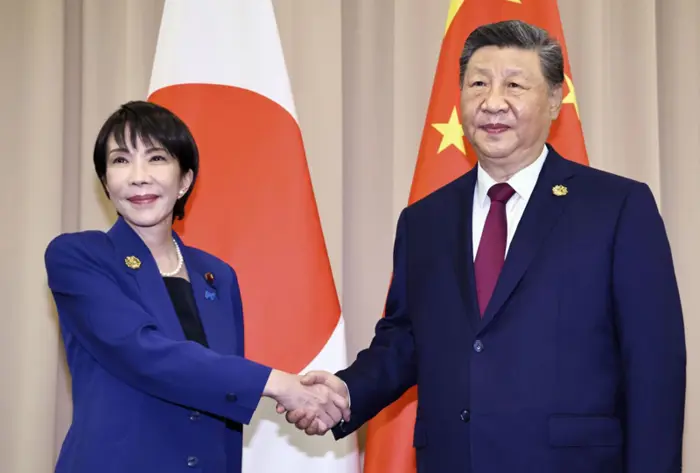
TOKYO, November 1: Japan’s newly appointed Prime Minister Sanae Takaichi has signaled a pragmatic and diplomatic approach to foreign policy during her first week in office, defying earlier concerns that her conservative and nationalist leanings might strain regional relations.
Within ten days of assuming office on October 21, Takaichi engaged in a series of high-level meetings, including bilateral summits with Chinese President Xi Jinping and South Korean President Lee Jae-myung, showcasing a commitment to stability, dialogue, and regional cooperation.
Takaichi, Japan’s first female prime minister, met President Xi Jinping on October 31 and President Lee Jae-myung on October 30 on the sidelines of the APEC Summit in Gyeongju, South Korea. Her diplomatic debut also included appearances at the ASEAN Summit on October 26 and a state visit by U.S. President Donald Trump in Tokyo from October 27 to 29.
Political analysts noted that her actions and tone reflect pragmatism over ideology, emphasizing continuity with Japan’s existing foreign policy rather than abrupt shifts.
“Statements made as a lawmaker differ greatly from those made as a national leader,” said Dr. Shin Kawashima, a Sino-Japan relations expert at The University of Tokyo.
“Prime Minister Takaichi understands the importance of balancing Japan’s national interests while maintaining regional stability.”
Despite being perceived as a “China hawk,” Takaichi has taken steps to ease tensions. She refrained from visiting the controversial Yasukuni Shrine during its autumn ritual, a move widely seen as a gesture of goodwill toward Japan’s neighbors.
In her inaugural Diet address, she called China “an important neighboring country” with which Japan must build a “constructive and stable relationship.”
President Xi Jinping, who initially did not send a congratulatory message upon her appointment, later praised her remarks during their meeting, saying he appreciated her Cabinet’s recognition of the significance of Sino-Japanese ties.
“China and Japan are neighboring countries separated by a narrow strip of water,” Xi said. “I would like to maintain communication with you and develop relations on the right track.”
Following their meeting, Takaichi told reporters she had frankly conveyed Tokyo’s concerns about China’s military activities and economic coercion but said both leaders agreed on the need for continued dialogue.
Takaichi’s summit with South Korean President Lee Jae Myung also marked a positive reset in Japan-Korea relations. Their meeting, initially scheduled for 20 minutes, lasted 45 minutes, underscoring an unexpectedly warm exchange.
Takaichi and Lee exchanged symbolic gifts. Lee presented her with Korean cosmetics and seaweed, while Takaichi offered traditional Japanese Go stones made in Kamakura, reflecting mutual respect and cultural understanding.
“Japan and South Korea have many shared challenges,” Lee said. “Through cooperation, we can solve not only domestic but also global issues.”
Both leaders agreed to maintain “future-oriented and stable ties,” with Takaichi extending an invitation for Lee to visit Japan soon.
Experts say the Takaichi-Xi-Lee trilateral diplomacy underscores a regional desire to stabilize East Asia amid U.S.-China tensions.
“The fact that Xi agreed to meet a known conservative so soon after her appointment suggests both countries seek stability under U.S. pressure,” observed Dr. Heng Yee Kuang of The University of Tokyo. “It was businesslike, cautious, but constructive exactly what the region needs.
While Takaichi’s conservative credentials once sparked fears of rising nationalism, her early diplomatic moves, from avoiding divisive symbolism to promoting mutual respect, signal a leader focused on realism and results.
In her words, Japan will “comprehensively promote a mutually beneficial relationship based on common strategic interests,” echoing the diplomatic philosophy of her mentor, the late former Prime Minister Shinzo Abe.
As the Asia-Pacific adjusts to shifting power dynamics, Prime Minister Takaichi’s pragmatic tone may set the stage for a new era of cautious but constructive engagement between Tokyo, Beijing, and Seoul.