

Bangladesh, Pakistan Seek to Boost Trade as Deputy PM Dar Visits Dhaka
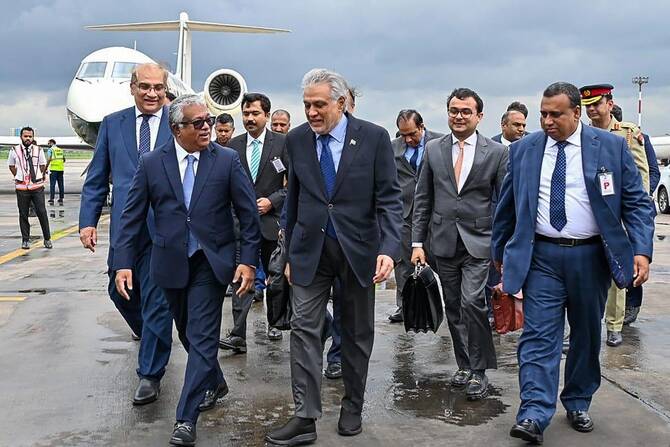
DHAKA: Bangladesh is aiming to deepen trade and economic ties with Pakistan as Islamabad’s Deputy Prime Minister Ishaq Dar arrived in Dhaka on Saturday, marking the highest-level Pakistani visit to the country in decades.
Dar’s two-day trip will include talks with Chief Adviser Prof. Muhammad Yunus and Foreign Affairs Adviser Touhid Hossain, with discussions set to cover bilateral relations, trade, and wider regional issues.
“During the visit of the Pakistani deputy prime minister, Bangladesh will focus on increasing bilateral trade and commerce and economic cooperation,” Yunus’ deputy press secretary, Azad Majumder, told Arab News.
The landmark visit comes after Yunus held two meetings with Pakistan’s Prime Minister Shehbaz Sharif over the past year, first at the UN General Assembly in New York in September and later at the D-8 Summit in Cairo in December. Both leaders had identified potential areas of cooperation, including textiles, sugar, and youth exchange programs.
Relations between Dhaka and Islamabad have historically been strained since Bangladesh’s independence in 1971, but recent months have seen both countries move toward reconciliation. Pakistan’s Commerce Minister Jam Kamal Khan visited earlier this week to push for trade expansion in agriculture and food security, while Pakistani cargo ships began arriving at Chittagong port last November for the first time since independence.
Former Bangladeshi ambassador to the US, Humayun Kabir, said the renewed engagement reflected a willingness to “make up for lost time” and normalize ties but stressed that unresolved historical issues, particularly Pakistan’s failure to address the atrocities committed during the 1971 war, could complicate progress.
“I think, in order to move forward with the bilateral relationship, a concrete decision should come from the Pakistan side in this regard,” Kabir said. “Once these pending issues are resolved, it will pave the road for a normal relationship, ultimately benefiting both sides.”
Dar’s visit, seen as a diplomatic breakthrough, is expected to set the tone for deeper economic cooperation while testing both nations’ ability to balance progress with historical sensitivities.