

Solar Farms Drive Malaysia’s Clean Energy Investment
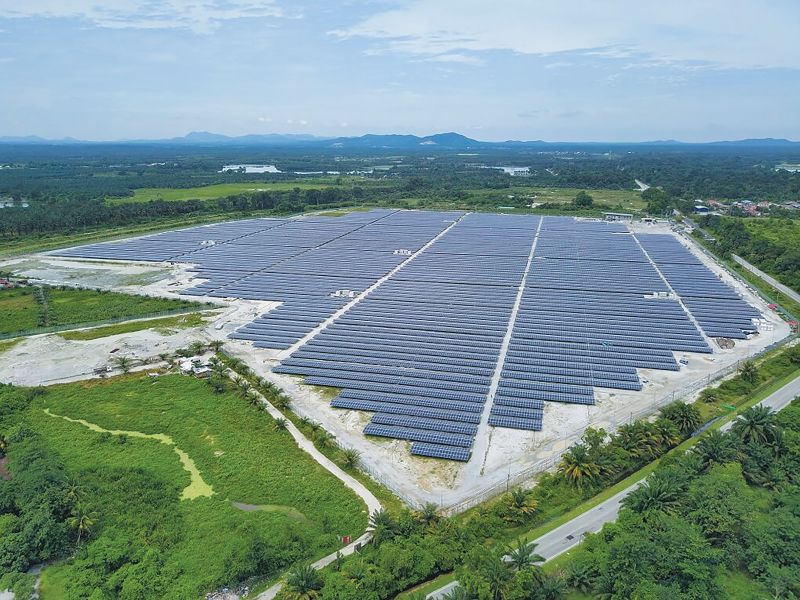
THE development of large-scale solar farms is increasingly becoming a new driver of clean energy investment in Malaysia, fuelled by growing demand from the corporate sector for electricity generated from renewable sources.
This development not only creates opportunities for local developers to expand their involvement in the renewable energy (RE) industry but also has the potential to attract investment, develop technological expertise and strengthen Malaysia’s position in the regional clean energy supply chain.
The implementation of the National Energy Transition Roadmap (NETR), Large Scale Solar (LSS) programme and Corporate Renewable Energy Supply Scheme (CRESS) also provides greater opportunities for the private sector to explore prospects within the industry.
Gading Kencana Sdn Bhd (Gading Kencana) Managing Director Datuk Dr Ir Muhamad Guntor Tobeng said the solar industry was expanding, driven by the needs of multinational companies that increasingly prioritise clean energy consumption to meet their respective sustainability targets.
According to him, Gading Kencana’s collaboration with Intel Malaysia to supply Renewable Energy Certificates (RECs) demonstrates the growing demand for green energy, particularly among international companies.
“RECs enable companies to demonstrate their use of renewable energy to fulfil environmental, social and governance (ESG) commitments without having to develop their own solar infrastructure.
“This development shows that large-scale solar farms have increasingly strong commercial potential, particularly as Malaysia continues to attract investment in the semiconductor, artificial intelligence (AI), data centre and high-tech manufacturing sectors,” he told Utusan Malaysia.
He said that over the next five to 10 years, solar farm development was expected to expand through increased generation capacity, the adoption of battery energy storage systems (BESS) and new business models connecting developers with corporate energy consumers.
“However, the sector’s growth depends on several key factors, including development costs, access to financing, certainty of investment returns and guaranteed demand for the energy generated.
“From a cost perspective, site selection is among the most critical considerations because a large area of land is not necessarily suitable for solar farm development if it is located far from grid nodes or lacks sufficient connection capacity.
“Land acquisition or leasing costs, solar panel installation, inverters, substations and grid connection infrastructure also influence project viability.
“Long connection distances can increase development costs and result in energy losses during transmission,” he said.
In addition, Muhamad Guntor said access to competitive financing was important as solar farm development requires substantial initial capital, while investment returns are generally realised over a long period.
“Financial institutions need to assess projects based on the strength of power purchase contracts, developers’ technical capabilities, asset performance and projected cash flow throughout the operational period.
“Project financing, green sukuk and institutional investment can also be expanded as alternatives to conventional bank financing to support industry growth.
“At the same time, government policy stability and regulatory transparency must be ensured to give investors the confidence to make long-term capital commitments.
“Mechanisms such as LSS and CRESS provide market access for developers, but policy continuity, tariff structures and grid usage charges must be clearly defined to reduce investment uncertainty,” he explained.
He said securing energy buyers was also a determining factor in a project’s bankability, as developers needed to ensure that the energy generated could be supplied and purchased at reasonable prices.
“In this regard, increasing demand from multinational companies, data centres, the semiconductor industry and the manufacturing sector is opening up greater market opportunities for local solar developers.
“Through CRESS, corporate consumers have the opportunity to obtain renewable energy supplies from developers through the existing grid network, subject to stipulated conditions and charges.
“This mechanism allows developers to explore long-term Power Purchase Agreements (PPAs) directly with corporate consumers.
“Contracts specifying the duration, price and amount of energy supplied can reduce market risks, thereby increasing financial institutions’ confidence in financing such projects,” he said.
He said rising electricity demand from data centres, particularly those supporting AI and cloud computing, also presented significant opportunities for the local solar industry.
“However, data centres’ need for a stable electricity supply around the clock requires solar energy to be combined with other energy sources, BESS and more efficient grid management.
“This is because solar power generation depends on weather conditions and occurs only during certain hours, requiring supporting systems to ensure continuity of electricity supply,” he said.
Utusan