

Bangladesh Faces Political Crossroads One Year After Hasina’s Ouster
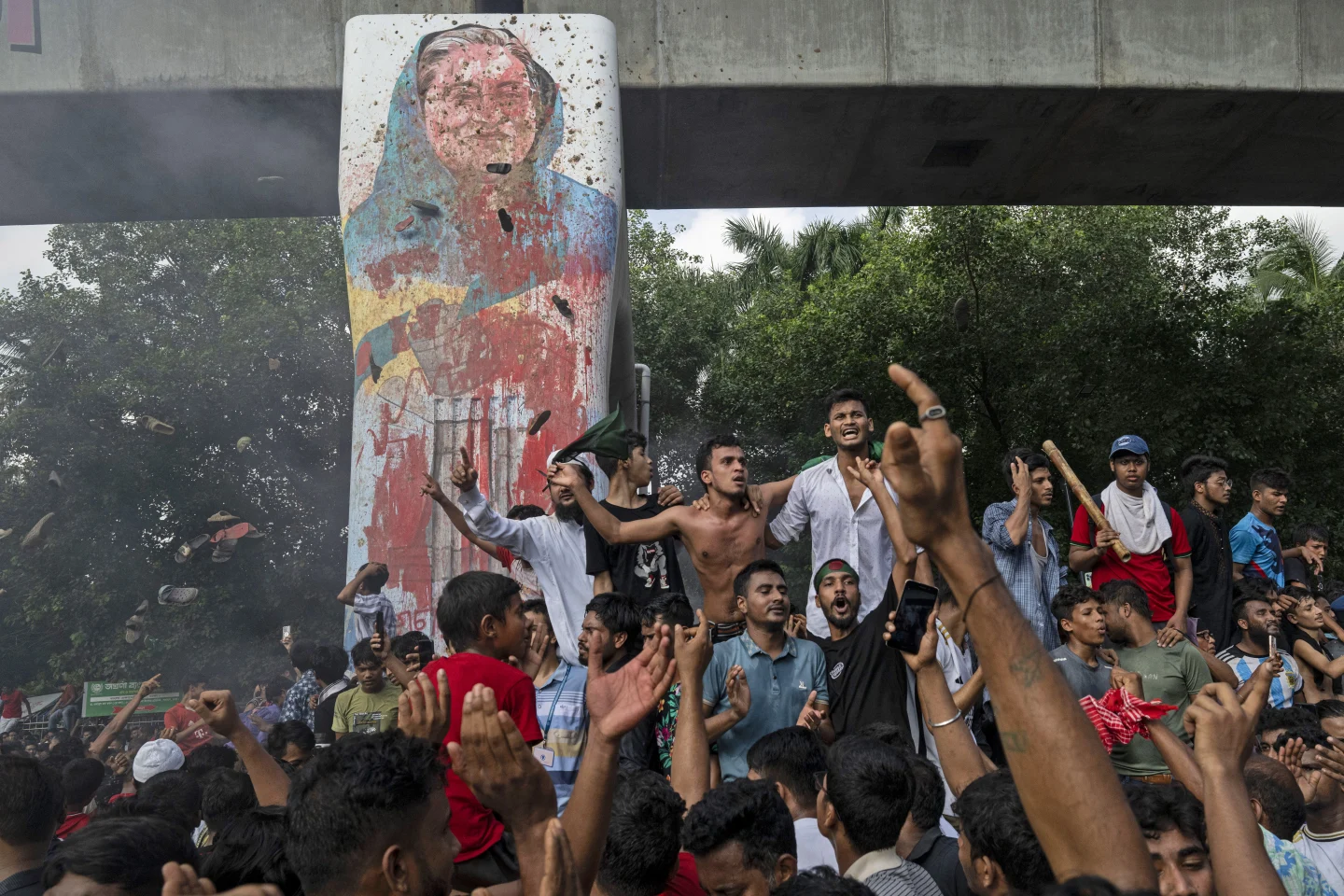
DHAKA, July 16, 2025 (VOM)— One year after a student-led uprising toppled former Prime Minister Sheikh Hasina and ended her 15-year rule, Bangladesh remains mired in political instability, deepening polarization, and growing uncertainty over its democratic future.
The fall of Hasina, who fled to India in the wake of mass protests and civil unrest that erupted on July 15, 2024, ushered in an interim government led by Nobel Peace Prize laureate Muhammad Yunus. The Yunus administration, formed with a mandate to stabilize the country and guide it toward credible elections, has struggled to maintain order, implement promised reforms, and unify a fragmented political landscape.
Upon assuming leadership, Yunus pledged a return to democracy through free and fair elections, constitutional amendments, and institutional reforms. However, with no election held to date and no firm date on the horizon, critics say the interim government lacks legitimacy and risks overextending its mandate.
Yunus has proposed a range of reforms—including term limits for the premiership, the introduction of a bicameral parliament, and judicial independence—arguing that these structural changes are essential before any vote can take place. He has tentatively proposed April 2026 for national elections.
But the delay has drawn criticism from both domestic political factions and civil society groups. The Bangladesh Nationalist Party (BNP) is demanding immediate elections, while the Jamaat-e-Islami party, which returned to formal politics after a decade-long ban, has aligned with Yunus’s vision for extended reforms.
Tensions have also emerged between the civilian government and the military after the army chief publicly advocated for elections by December 2025—a position Yunus rejected.
The student protesters who led the 2024 uprising have since formed a new political party, positioning themselves as a breakaway alternative to the country’s historically dominant parties: the BNP and Hasina’s Awami League, which was officially banned in May. Hasina is currently facing trial for crimes against humanity related to actions during her time in office.
However, the student-led party’s perceived proximity to the Yunus administration has raised concerns about impartiality and political manipulation.
Meanwhile, the re-emergence of the Jamaat-e-Islami has further complicated the political equation. The Islamist party, long seen as controversial for its opposition to Bangladesh’s 1971 independence, is now vying for influence alongside smaller religious factions advocating for stricter Islamic laws and limits on women’s rights.
While the Yunus administration has been credited for halting enforced disappearances and extrajudicial killings previously reported under Hasina’s government, human rights concerns remain acute.
Minority communities, particularly Hindus, have reported a surge in targeted violence over the past year. The Bangladesh Hindu Buddhist Christian Unity Council claims hundreds of attacks have gone unpunished, while the interim government maintains that security efforts are being improved nationwide.
Human Rights Watch has welcomed the end of state-sanctioned repression but noted that institutional reform of the security apparatus has yet to be meaningfully realized.
Bangladesh’s foreign policy has also undergone a recalibration. Previously a close ally of India, the country under Yunus has moved closer to China, signing new investment and infrastructure agreements during a high-level visit to Beijing in March.
India, in response to the ouster of its long-time ally Sheikh Hasina, has suspended visa issuance to Bangladeshi citizens and ignored Dhaka’s requests to extradite the former prime minister.
Meanwhile, the interim government has garnered support from Western countries and the United Nations. However, relations with the United States have been complicated by the Trump administration’s suspension of USAID funding in January, forcing Dhaka to seek alternative development financing.
As the country marks one year since its political upheaval, the path forward remains unclear. Deep political rifts, stalled reform talks, and an unsettled security environment threaten to derail the transition process.
“The original promise was to restore democracy and trust,” says Michael Kugelman, a South Asia expert at the Asia Pacific Foundation. “But in the absence of a clear mandate, and with reforms turning into points of contention, the interim government is struggling to meet the high expectations it set.”
Bangladesh now faces a critical juncture: deliver institutional reforms without eroding public trust or move ahead with elections under unresolved conditions. Either way, the outcome will have lasting implications for the country’s political trajectory.