

Israelis Take Refuge in Underground Train Stations Amid Ongoing Missile Barrage from Iran
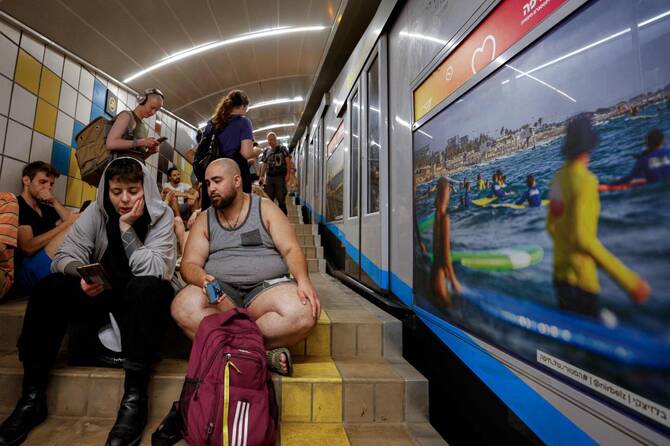
RAMAT GAN, ISRAEL | June 21— As Iranian missile and drone attacks continue to rain down on Israeli cities, hundreds of civilians are now spending their nights in underground train stations, transforming public transit infrastructure into makeshift shelters.
Among them is 34-year-old event planner Aziza Melech, who described the relief of laying down her inflatable mattress in the brightly lit underground station straddling Tel Aviv and Ramat Gan. “It’s the first time in days I’ve felt safe enough to relax,” she said.
Life Underground Amid War
Since Israel’s June 13 airstrikes on Iranian military and nuclear targets ignited full-scale hostilities, the Iranian military has responded with unprecedented force—firing over 450 missiles and more than 1,000 drones, according to the Israeli military. The attacks have left 24 people dead and hundreds injured across Israel, with strikes reported on 40 separate sites, including residential buildings and hospitals.
Melech and others, fearing the surprise of late-night sirens, have sought shelter underground. Many arrive each evening carrying mattresses, sleeping bags, food, and even pets. Parents tuck their children in with stuffed animals, while young adults pass the time with tablet movies and pizza boxes.
“It’s very scary to run to the shelter every time,” said Sonia Shraibmen, Melech’s friend, who chose to sleep underground after falling while racing for safety during a recent missile alert.
A Scene Reminiscent of Wartime History
Melech compared the situation to the stories her grandfather told about World War II. “Now we’ll have our stories to tell our grandkids—nights in the station, sirens blaring above.”
The Tel Aviv light rail, currently shut down due to the conflict, has several underground stations that serve as makeshift bunkers each night. Local volunteers have stepped in to provide coffee, snacks, and even children’s entertainment programs to make the atmosphere more bearable.
Foreign workers are among the most vulnerable.
Roughly half of those sleeping in the train stations are foreign workers, many of whom live in older apartments lacking reinforced shelters. While modern Israeli buildings are legally required to include safe rooms, poorer communities—particularly Arab neighborhoods and foreign worker housing—often lack this protection.
“I’ve lived here 10 years, but this week has been something else,” said Babu Chinabery, a home health aide from India. “The missiles are too strong. That’s why we’re here.”
Shelter Beyond the Train Lines
The underground stations aren’t the only improvised shelters. Organizers have also opened an underground mall parking garage, where over 400 people now sleep in tents arranged in parking spaces. Tel Aviv’s long-abandoned Central Bus Station atomic shelter was reopened to the public, though its unsanitary and eerie condition discouraged most from using it.
No Risks for Young Families
Roi Asraf, 45, brought his wife and 3-year-old daughter to the Ramat Gan train station, even though they have a safe room at home. “I don’t like to take unnecessary risks,” he said.
Their evening routine now includes a bath, pajamas, and a walk to the station by 7 p.m., followed by a children’s show hosted by volunteers. “If I have to sleep a week of my life in a train station for everything to be safer, I’m willing to do it,” he added.
A Nation on Edge
The ongoing conflict has displaced thousands across both Iran and Israel, with civilian casualties rising on both sides. According to a U.S.-based Iranian human rights group, over 600 people, including more than 200 civilians, have died in Iran since the conflict began.
With the war showing no signs of slowing and missile sirens continuing nightly, many Israelis are adapting to a new reality—one where safety comes not from home, but from the concrete walls of a transit station below ground.