

Who Will Be Prime Minister If BN and PN Join Forces?
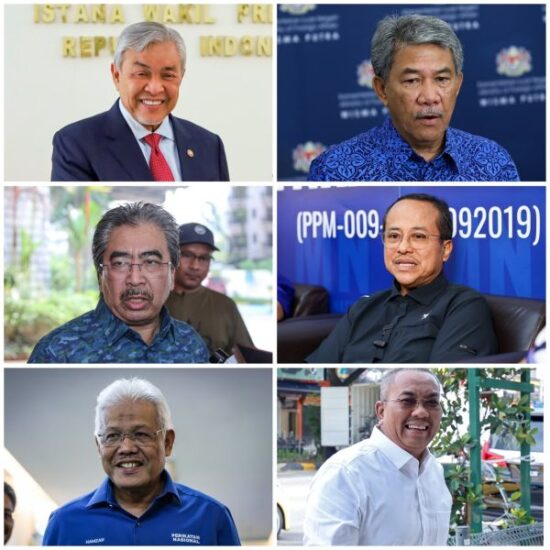
IF Barisan Nasional (BN) and Perikatan Nasional (PN) decide to form a political alliance, the biggest question that will arise will no longer be merely about seat allocation, but rather who will lead the government.
The question of who will become prime minister is important because both blocs have experienced political figures with their own backgrounds, positions and influence.
From BN, among the names frequently mentioned are UMNO President and BN Chairman Datuk Seri Dr Ahmad Zahid Hamidi, UMNO Deputy President Datuk Seri Mohamad Hasan and UMNO Vice-President Datuk Seri Johari Abdul Ghani.
Ahmad Zahid is also currently the Deputy Prime Minister and Minister of Rural and Regional Development.
His position within BN’s leadership structure makes him one of the key figures who would naturally be involved in discussions should a new alliance be formed.
Mohamad, better known as Tok Mat, has extensive administrative experience, including having served as Negeri Sembilan Menteri Besar, and currently holds the position of UMNO Deputy President.
His experience in both state and federal politics also makes him one of the names that could be considered in any leadership negotiations.
Johari, meanwhile, brings a different profile, with experience in economics and the corporate sector, in addition to currently holding a ministerial position in the Cabinet. His involvement in managing the national economy makes him another BN figure who could emerge in discussions over government leadership.
Within PN, the name of its Chairman, Datuk Seri Dr Ahmad Samsuri Mokhtar, has become increasingly important in the coalition’s leadership structure.
He is also the Terengganu Menteri Besar and had taken over the position of Opposition Leader in Parliament in 2026 before further changes took place in the opposition leadership.
The name of Datuk Seri Muhammad Sanusi Md Nor also cannot be overlooked. The Kedah Menteri Besar is among the key figures in PAS and PN, having previously served as PN Treasurer before the coalition’s administrative structure was reshuffled in June.
Another name from PN is Datuk Seri Hamzah Zainudin. Although his position within PN’s structure has undergone changes throughout this year, he has extensive experience at the federal level and has held several Cabinet portfolios as well as opposition leadership positions.
However, if BN and PN do join forces, the selection of a prime minister will not necessarily be determined solely by who holds the most senior position in their respective parties.
Negotiations over the number of seats, support from Members of Parliament, agreements among component parties and the formula for forming a government will be among the main factors.
The question could become even more complicated if both blocs wish to maintain their respective party identities and structures.
A political alliance does not necessarily mean that all parties must merge their organisations. Instead, it could take the form of an understanding or cooperation based on an agreed formula.
UMNO-PAS Strengths Are Balanced
Political analyst Dr Mazlan Ali said that although UMNO has longer experience in governing the country, the strengths of the two Malay-based parties are now seen as more balanced, with PAS even holding an advantage in terms of the number of parliamentary seats.
He said experience alone could no longer be used as the benchmark for determining which party would lead the government if UMNO and PAS cooperated.
“If we base it on experience, UMNO would certainly be more suitable to provide the prime minister. But at present, the strengths of UMNO and PAS are already balanced.
“In fact, under certain circumstances, PAS appears to be stronger than UMNO,” he said.
According to him, the number of seats won in the next general election will be the main determining factor in deciding which party has a stronger basis for putting forward a prime ministerial candidate.
“If PAS wins more seats, then PAS will provide the prime minister. If UMNO wins more seats, then UMNO will provide the prime minister,” he said.
Mazlan said that apart from Ahmad Zahid and Johari, there are other figures whom UMNO could potentially put forward in the future, including Khairy Jamaluddin.
As for PAS, besides Ahmad Samsuri and Muhammad Sanusi, the party also has no shortage of suitable candidates, including its Secretary-General, Datuk Seri Takiyuddin Hassan.
Meanwhile, Mazlan said BN-PAS cooperation is seen as important if both parties want to reduce the splitting of Malay votes in the next general election.
He said BN faces difficulties in securing substantial Malay support without PAS, while separate contests between the two parties could result in a split in Malay votes.
“At present, UMNO sees PAS as a party that can help it return to leading the country. UMNO could win more seats, especially in Malay-majority constituencies.
“PAS also has experience governing four states and can help UMNO develop the country, strengthen governance and establish long-term stability,” he said.
He said that if cooperation between the two parties materialises, the Malay-Muslim unity agenda could potentially become one of the main foundations of the political alliance.
He added that unity among the Muslim community could serve as the core of efforts by UMNO and PAS to form a united team ahead of the upcoming 16th General Election (GE16).
UTUSAN