

Local purchases by the Saudi government hit 51%: Alkhorayef
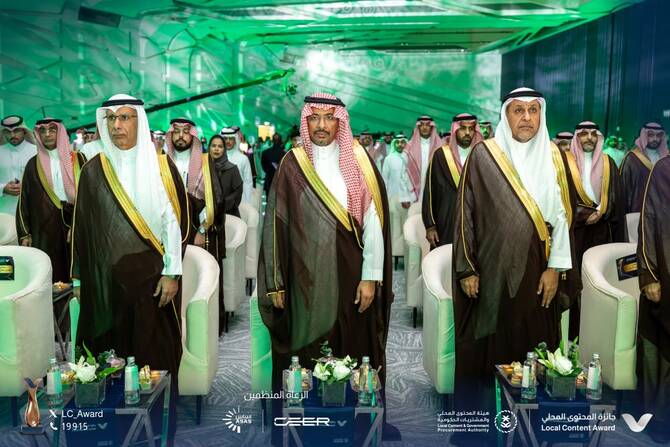
RIYADH: Bandar Alkhorayef, Saudi Arabia’s Minister of Industry and Mineral Resources, said on Monday that local content in government purchases went over 51% in 2025.
The Local Content and Government Procurement Authority hosted the fourth Local Content Award event in Riyadh, where they provided the information.
The event focused on efforts to increase local content, which is an important part of Vision 2030’s plan to make the Kingdom’s industries stronger and less reliant on imports.
On his main address, Alkhorayef said that by the end of 2025, more than 51% of government purchases would be made with local content, up from 28% in 2018.
He said the rise was due to a change in how the government and private sector buy things: they are now spending more on local items, which reflects a growing commitment to support domestic industries and reduce dependency on foreign goods. As part of its transformation strategy, Saudi Arabia wants to raise the share to 70% by 2030.
Alkhorayef also said that the authority has kept using rules and tools to help local material, which includes initiatives aimed at increasing local procurement and supporting domestic suppliers.
He said that since the industry-localization and knowledge-transfer method was put into place in 2021, 80 agreements have been signed, and investments will have reached more than SR18 billion ($4.8 billion) by the end of 2025.
There were also 27 award winners from the public, private, nonprofit, and individual fields at the event.
Even more people applied for the awards than the last time, with more than 131% more applications than the last time.
There were 22 awards and five certificates given out at the event. Two new categories were added for nonprofits to recognize their important role in promoting local content and economic and social growth.
The Zakat, Tax, and Customs Authority was first in the high-spending track for government organizations. The Ministry of Transport and Logistic Services came in second, and the Ministry of Human Resources and Social Development came in third.
A ZATCA spokesperson, Humoud Al-Harbi, told Arab News that the group has taken steps to improve local content through procurement and internal processes.
“We are working on a number of projects to create local content, set up mechanisms for it, and also improve the quality of the practices that go along with it,” he said.
Al-Harbi said that the work has helped create jobs and increased the use of local providers.
The Roads General Authority came in first for excellence in local content for medium- and low-spending entities. The Ministry of Energy came in second, and the Saudi Ports Authority came in third.
The executive general director of risk management and business continuity at the Saudi Ports Authority, Arif Al-Ruhaimi, said that the organization started 19 projects, with 11 of them focusing on local material.
“These initiatives touched on all aspects of local content in all of its parts,” he said. “They did this whether it was localizing services, localizing industrial parts, or localizing human resources.”
“They also paid a lot of attention to supply chains or value chains, since ports are, as you know, critical parts of these chains.”
“In light of this, their involvement and support in increasing local content will definitely make supply chains better and more sustainable.”
Al-Ruhaimi said that the authority wants to increase the amount of local content in its purchases from about 50 percent now to 75 percent by 2030. They will also help the private sector hit 65 percent by providing resources, training, and incentives to encourage the use of local materials and services.
Besides that, these local content programs should also make about 4,000 jobs available by 2030, he said.
For state-owned businesses, STC Group won the award for preferring local material, followed by Matarat Holding in second place and National Water Co. in third.
In the private sector, Intra Defense Technologies won an award for a small or medium-sized business in the manufacturing and mining field, while International Maritime Industries won an award for a large business.
The Nusuk for Hajj and Umrah Foundation was one of the nonprofits recognized for its work to promote local material.
People were also praised for making more people aware of how local material can help the national economy, particularly through initiatives that encourage the use of locally sourced products and support local businesses. Hattan Tashkandi won first place, followed by Yara Al-Shehri and Yousef Al-Mazyad.