

Right on time: Riyadh Metro designs innovative urban transportation
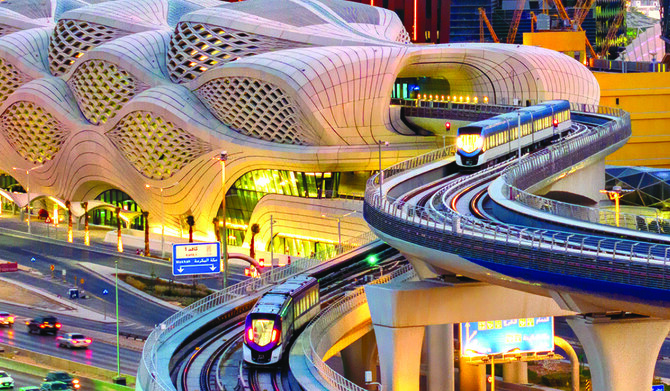
The Riyadh Metro is establishing a new benchmark for urban transportation in the Kingdom in a metropolis where rapid development has exceeded infrastructure. The $23 billion mega-project, comprising six lines, 176 kilometers of track, and 85 stations, is one of the largest metro systems constructed in a single phase.
The complicated urban and geological settings of Riyadh presented special difficulties during building. The dense limestone and breccia beneath the city’s surface necessitated the use of specialized tunnel boring machines, or TBMs, designed to navigate these challenging conditions.
“The geological conditions demanded not only technical sophistication but also real-time adaptability to ensure both speed and accuracy,” said Roger Cruickshank, senior director of AtkinsRealis, which oversaw the design of Lines 4, 5, and 6, in an interview with Arab News.
The metro strategically positioned its eleven underground and seventeen at-grade stations to enhance connectivity throughout the city. Furthermore, taken into great thought was Riyadh’s current road system’s integration of elevated, at-grade, and underground tracks.
“Minimizing disturbance mostly depends on restructuring road networks and guaranteeing seamless transitions between modes of transportation,” Cruickshank added.
The Riyadh Metro’s Level 4 automation—which replaces onboard operators—is one of its defining characteristics. By using sophisticated algorithms and real-time data, centralized control centers control operations and guarantee flawless functionality.
Automated data-collecting systems and fiber optic sensors are two types of geotechnical monitoring tools that help this system work. These tools constantly check the condition of the infrastructure.
“These technologies give real-time insights that let us forecast and handle maintenance needs before they become more severe,” Cruickshank added.
Modern safety elements like early warning and remote diagnostic devices on the trains themselves improve passenger safety and operational dependability.
Predictive analytics minimize downtime and increase the lifetime of important components, hence optimizing system performance.
The metro stations strike a compromise between form and utility. Designed to maximize passenger flow and connectivity, they also express Riyadh’s cultural identity by means of architectural features influenced by local legacy.
Cruickshank added, “The design combines modern materials with traditional influences, making the infrastructure both practical and a visual complement to the city.”
The metro connects major cities, thereby reducing the reliance on cars in a city notorious for traffic congestion. The emphasis on accessibility guarantees that the system fairly serves Riyadh’s expanding population.
The Riyadh Metro, with its emphasis on sustainability, aligns with Saudi Arabia’s Vision 2030, which aims to significantly reduce carbon emissions by promoting public transportation.
To further reduce its environmental impact, the system also includes energy-efficient technology, such as automatic lighting and regenerative braking.
Cruickshank stated, “Noise and vibration mitigating measures were vital to guarantee the system operated harmoniously within the urban environment.” These steps underline the dedication of the project to environmental preservation together with the inclusion of green construction criteria.
Already guiding next projects in Saudi Arabia and beyond are the lessons learned from the project. “This project shows how cooperation, cutting-edge technology, and strategic planning can generate technically excellent and environmentally friendly infrastructure,” Cruickshank added.
The Riyadh Metro is a case study for cities all over, dealing with issues of mobility and urbanization. By combining engineering excellence, technological innovation, and cultural sensitivity, authorities have created a transit network that not only meets today’s needs but anticipates the demands of tomorrow as well.