

Anwar Urges Fairer Global Order at BRICS 2025, Says Global South Now a Force to Be Reckoned With
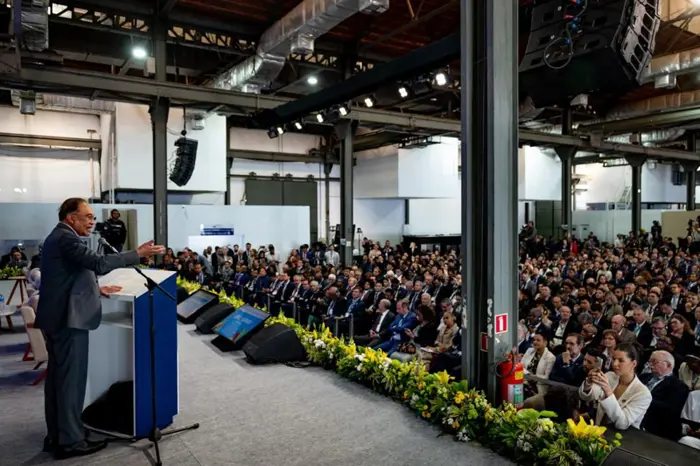
RIO DE JANEIRO|| July 5: Prime Minister Datuk Seri Anwar Ibrahim has called for bold reforms in the global governance system, declaring that the Global South must no longer be seen as a peripheral actor but as a formidable force in the international arena.
Speaking at the BRICS Business Forum on Saturday, Anwar said developing nations are now demonstrating strength in technology, trade, leadership, and moral values and must be accorded greater weight in shaping the future global order.
“The Global South has risen. We are not just catching up—we are stepping forward. BRICS is no longer about political rhetoric. It is a coalition of power, economy, and civil society united in pursuit of a fairer and more equitable global system,” Anwar said.
He praised BRICS’ inclusive approach, highlighting its engagement with not just governments but also the private sector, women, youth, and civil society—a combination he described as collective, resilient, and transformative.
Representing Malaysia as the 2025 ASEAN Chair, Anwar reaffirmed Southeast Asia’s commitment to multilateralism, the promotion of intra-ASEAN trade, and the adoption of local currencies in cross-border transactions—all aimed at building a more stable and independent financial system.
“This is a tangible step toward reducing reliance on a single dominant currency and reshaping a financial structure free of unilateral domination,” he said.
Anwar also stressed the need for closer strategic cooperation between BRICS and ASEAN, particularly in expanding trade and investment flows among developing nations.
Calling for sweeping institutional reforms, Anwar said the United Nations, International Monetary Fund (IMF), World Bank, and World Trade Organization (WTO) must evolve to reflect the realities and needs of today’s global community—especially the Global South.
“We must not remain confined to outdated post-World War II frameworks. The time has come for major reform of global institutions to ensure equity, representation, and effectiveness,” he asserted.
Anwar concluded by urging leaders to use the BRICS 2025 Summit not merely as a continuation of past initiatives but as a starting point for a new global paradigm.
“With visionary leadership, a progressive public sector, and unity across the Global South, we have a genuine opportunity to reshape the global landscape—one that serves all nations, not just the privileged few,” he said.
The BRICS 2025 Summit brings together major emerging economies, including Brazil, Russia, India, China, and South Africa, with growing participation from developing nations seeking greater voice and agency on the world stage.