

Voice-cloning technology is “bringing to life” a significant US Supreme Court ruling
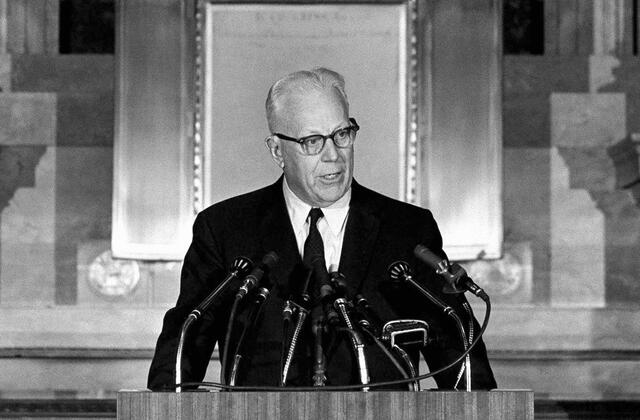
NEW YORK: On this Friday, seventy years ago, Chief Justice Earl Warren made the historic desegregation of schools ruling in Brown v. Board of Education known to no one outside the US Supreme Court building.
It is now feasible for people to “hear” Warren read the ruling as he did on May 17, 1954, along with oral arguments made by attorneys, including Thurgood Marshall, who would go on to become a justice of the Supreme Court, thanks to cutting-edge voice-cloning technology.
The replica of “Brown Revisited” can be accessed at brown.oyez.org. It will be included in a website that former Northwestern University professor Jerry Goldman laboriously assembled, allowing users to listen to oral arguments in several decades’ worth of Supreme Court cases and follow along with written transcripts.
However, Goldman was constantly irritated by the court’s decision to start recording oral arguments only a year after the Brown ruling was rendered, in 1955. Transcripts in print are simply not the same.
He answered, “I could give you Madame Butterfly’s libretto.” But which would you prefer—reading it or watching the act on stage?
A turning point in the civil rights movement was the Brown ruling.
The court ruled that the 1896 verdict, which established “separate but equal” schools for Black and White pupils, was unjust and invalidated the practice of racial segregation.
Even though the court started recording arguments in 1955, very few people actually listened to them until 1969, when the National Archives made them accessible for academic and legal inquiry. Complete open access was not provided until 1993.
In the 2000s, the court started to release arguments online, but usually a few days later.
The court didn’t begin to regularly stream the arguments live until 2020. There has always been a ban on cameras.
Goldman claimed that after seeing a play a year prior in which a well-known voice was artificially recreated by artificial intelligence, he began to wonder if such technology could be applied to landmark legal disputes.
When contacted, James Boggs, CEO of the interactive audio company Spooler and a Northwestern alum, expressed interest.
Goldman stated, “It’s important to bring attention to this case because it altered America and is essential to our comprehension of the Constitution.”
The first stage was to locate recordings of the case’s deceased principals, ideally from around 1954 so that you could get a sense of their voice at that time. In the examples of Marshall and former California governor Warren, that was not difficult. John W. Davis, an opponent of integration whose extensive career included the Democratic presidential nomination in 1924, found it more difficult. 1955 saw his death.
It was possible to locate a Davis recording by using the Library of Congress. Some other participants’ recordings were not found.
These actors’ voice samples were combined with historical transcript reading actors’ voice samples via artificial intelligence to create the impression that they were speaking in a fresh way.
The actual discussions lasted for eighteen hours, three days, and involved thirty-eight people. Goldman condensed everything into a presentation that lasted one hour and forty-five minutes, which included Warren reading the ruling.
By consulting Warren’s handwritten notes, Goldman was able to incorporate the chief justice’s focus on the ruling being unanimous into the reenactment.
Although the ability of technology to replicate sounds is amazing, many people are deeply concerned that it could put bogus words into well-known voices. Deepfakes are a particular worry as we approach the presidential election.
These actors’ voice samples were combined with historical transcript reading actors’ voice samples via artificial intelligence to create the impression that they were speaking in a fresh way.
The actual discussions lasted for eighteen hours, three days, and involved thirty-eight people. Goldman condensed everything into a presentation that lasted one hour and forty-five minutes, which included Warren reading the ruling.
By consulting Warren’s handwritten notes, Goldman was able to incorporate the chief justice’s focus on the ruling being unanimous into the reenactment.
Although the ability of technology to replicate sounds is amazing, many people are deeply concerned that it could put bogus words into well-known voices. Deepfakes are a particular worry as we approach the presidential election.
Although consent cannot be obtained from the deceased, Ravit Dotan, CEO of TechBetter and lecturer on technology ethics, expressed worry about the practice of cloning people’s voices without their permission. She thinks “Brown Revisited” creates an unfavourable precedent.
“Like copyright, which expires 70 years after the creator’s death, I can envision laws in the future determining how long a person’s likeness rights persist after their death,” Dotan added. “But since there isn’t any legal guidance at the moment, I’m concerned that people will take advantage of this and use people’s likenesses or even spread false information.”
The Brown endeavour is a “deep true” as opposed to a “deepfake,” according to Boggs.
He declared, “We are not producing new content.” “We have the historical documentation to prove that these were actually said.”
Like recreations have an inherent boundary. Voice recordings were not made available until the late 1800s. If you went back farther, they would basically be conjectures. Who knows what the real voice of George Washington was like?
But the “Brown Revisited” project provides a fresh perspective on history for those who are inquisitive. – AP